
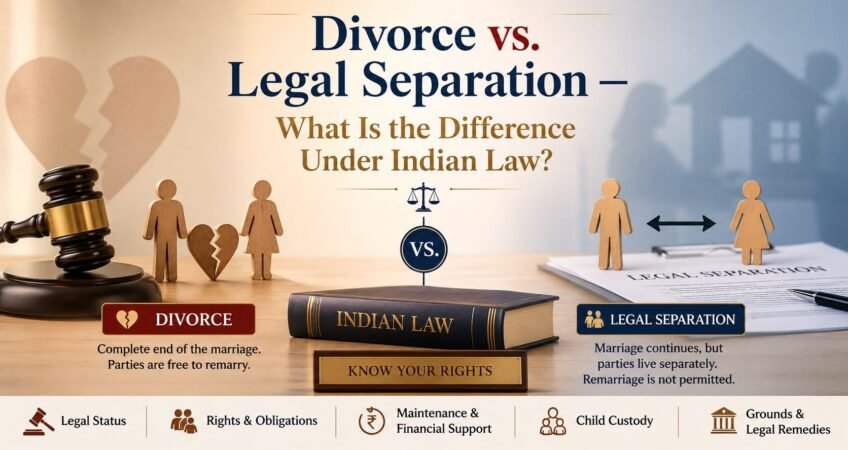
Divorce vs. Legal Separation — What Is the Difference Under Indian Law?
Written by Adv. Karan Dua Matrimonial Law Specialist | Delhi High Court & Supreme Court of India 8 Years Exclusive Practice in Family & Matrimonial Law | Jangpura, New Delhi.
Every week, someone walks into my office and asks some version of the same question: ‘Do I have to divorce? Can I just separate legally?’ Sometimes it comes from someone whose religion does not permit remarriage and who simply wants to live apart with legal protection. Sometimes it comes from a couple who genuinely are not sure whether the marriage is over or just going through its worst period. Sometimes it comes from a wife who needs maintenance and residence protection right now, but is not emotionally ready to dissolve the marriage permanently.
In each of these situations, the answer is the same: yes, Indian law offers an alternative to divorce. It is called judicial separation. And almost nobody knows how it works.
This article explains, in plain terms, what divorce and judicial separation are, how they differ from each other, when one is more appropriate than the other, and what the practical consequences of each choice are for you, your children, and your property.
If you are trying to decide between divorce and legal separation, read this article before you file anything. The choice you make at the beginning of this process will shape your rights — and your options — for years to come.
-
What Is Divorce Under Indian Law?
Divorce is the permanent, legal dissolution of a marriage. Once a court grants a divorce, the marriage is over. Both parties become legally single, regain the right to remarry, and their legal ties to each other — in terms of inheritance, conjugal rights, and personal status — are severed.
In India, the right to divorce is governed by personal law:
- Hindus, Sikhs, Buddhists, and Jains — Hindu Marriage Act, 1955 (HMA), primarily Section 13
- Muslims — Muslim Personal Law (Shariat) Application Act, 1937; triple talaq is now criminalised under the Muslim Women (Protection of Rights on Marriage) Act, 2019
- Christians — Divorce Act, 1869 (amended 2001)
- Parsis — Parsi Marriage and Divorce Act, 1936
- Inter-religion / civil marriages — Special Marriage Act, 1954 (SMA), Section 27
Grounds for Divorce Under the Hindu Marriage Act
Section 13 of the HMA allows either spouse to seek divorce on the following grounds:
- Adultery — voluntary sexual intercourse with a person other than the spouse
- Cruelty — physical or mental cruelty that makes it unreasonable to expect the petitioner to live with the respondent
- Desertion — abandonment for a continuous period of at least two years
- Conversion — the respondent has converted to another religion and is no longer a Hindu
- Mental disorder — the respondent is of unsound mind or has been suffering continuously from a mental disorder of such a kind that it is not reasonably possible to live together
- Leprosy (active) or venereal disease in a communicable form
- Renunciation of the world — entering a religious order
- Presumption of death — not heard of as being alive for seven years
Additional grounds available only to the wife include: husband’s conviction for rape, sodomy or bestiality; non-payment of maintenance; repudiation of marriage (option of puberty); and a first marriage by the husband before the HMA came into force.
Under Section 13B of the HMA and Section 28 of the SMA, both parties may also jointly file for divorce by mutual consent — the most common and least contentious route.
-
What Is Judicial Separation (Legal Separation) Under Indian Law?
Judicial separation is a court order that legally suspends the marital obligations between two spouses — while keeping the marriage itself intact. After a decree of judicial separation is passed, the parties are no longer required to cohabit. They live apart, with the full authority of a court order behind that separation.
But — and this is the critical point — they are still legally married. Neither party can remarry. The marriage continues to exist as a legal entity.
Where Is It Provided in Law?
- Section 10 of the Hindu Marriage Act, 1955 — for Hindu marriages
- Section 23 of the Special Marriage Act, 1954 — for civil marriages
- Section 22 of the Indian Divorce Act, 1869 — for Christian marriages
- Section 34 of the Parsi Marriage and Divorce Act, 1936 — for Parsi marriages
Grounds for Judicial Separation
Under Section 10 of the HMA, judicial separation can be sought on any of the same grounds as divorce under Section 13. This includes cruelty, desertion, adultery, conversion, mental disorder, and others. The petitioner does not need to prove anything more or different — the only difference is the relief sought.
In other words: if you have a ground for divorce, you also have a ground for judicial separation. You choose which remedy to pursue.
Practitioner’s Note: Section 10(1A) of the HMA also provides that if parties have been living separately for one year or more following a decree of judicial separation, either party may then petition for divorce. Judicial separation can, in practice, be a stepping stone to divorce — or a permanent arrangement.
-
The Core Differences: Divorce vs. Judicial Separation
The table below captures the most important legal and practical differences between the two.
| Factor | Divorce | Judicial Separation |
| Effect on marriage | Marriage is permanently dissolved | Marriage continues; only cohabitation duty suspended |
| Right to remarry | Yes — both parties may remarry after decree | No — neither party may remarry |
| Statute (HMA) | Section 13 / 13B | Section 10 |
| Grounds required | Same as judicial separation | Same as divorce — no extra threshold |
| Reversibility | Irreversible once final decree is passed | Parties may resume cohabitation any time by consent |
| Conversion to divorce | N/A | Either party may file for divorce after 1 year of separation (S.10(1A) HMA) |
| Inheritance rights | Severed — ex-spouses cannot inherit from each other | Preserved — spouses still inherit from each other by default |
| Maintenance / alimony | Permanent alimony can be granted (S.25 HMA) | Maintenance can be ordered (S.25 HMA applies) |
| Child custody | Decided as part of divorce decree | Court can decide custody during judicial separation |
| Property | Court may divide matrimonial assets | Property rights continue; court may pass interim orders |
| Emotional finality | Permanent and complete | A pause — keeps options open |
| Religious considerations | Some religions do not permit remarriage | Often preferred by those whose faith prohibits divorce |
-
Why Would Someone Choose Judicial Separation Over Divorce?
This is the question I am asked most often. If you can get a divorce, why settle for a judicial separation? The answer depends on who is asking.
Reason 1: Religious or Personal Objection to Divorce
For many families in India — particularly among Catholics, some Hindu orthodox communities, and some Muslim sects — divorce carries a profound religious stigma or is doctrinally prohibited. Judicial separation allows these individuals to live apart, have full court protection, receive maintenance, and be free of the obligation to cohabit — without crossing the religious line of dissolving the marriage.
Reason 2: The Marriage May Still Be Salvageable
Sometimes a couple needs space, not a severance. A judicial separation gives both parties time to reflect without permanently burning bridges. The decree can be set aside at any time if both parties agree to resume living together. Divorce, once granted, cannot be undone.
Reason 3: Inheritance Protection
Under Hindu succession law, a divorced spouse loses inheritance rights. A judicially separated spouse does not. If one spouse is terminally ill, elderly, or significantly wealthy, the other spouse may prefer judicial separation precisely because it preserves succession rights that divorce would extinguish.
Reason 4: Immediate Relief Without Full Commitment
A wife who is being subjected to cruelty, economic abuse, or harassment may need a court order immediately — for protection, residence, and maintenance — but may not be emotionally ready to seek a divorce. Judicial separation gives her all of that relief with the same speed and on the same grounds, without requiring the finality of divorce.
Reason 5: Visa, Immigration, or Foreign Law Considerations
Some NRI clients prefer judicial separation because their immigration status in a foreign country is tied to the marriage. A divorce would trigger visa or residency complications; a judicial separation allows them to live apart while legally maintaining the marital status that underpins their visa category. This is a niche but genuinely important consideration.
Reason 6: Children’s Psychological Stability
Some parents prefer not to subject their children to the word ‘divorce’ — particularly when the children are young. A judicial separation achieves the same practical separation while allowing the family to navigate a slower, less traumatic transition. Custody and maintenance arrangements can be made by the court in the same proceedings.
-
Why Would Someone Choose Divorce Over Judicial Separation?
Reason 1: You Want to Remarry
This is the most common reason. Judicial separation does not allow remarriage. If you are certain the marriage is over and you want to move on with your life — including the possibility of a new relationship that you can legally formalise — divorce is the only option.
Reason 2: Permanent Financial Clean Break
Judicial separation keeps the financial relationship between the parties partially alive — particularly with respect to inheritance. Divorce provides a definitive financial severance, which may be preferable where the parties have complex business interests, jointly held property, or where one spouse does not want the other to have any future claim against their estate.
Reason 3: Emotional and Legal Closure
For many people, the permanence of divorce is its most important feature — not a drawback. The certainty that the relationship is legally over, that there will be no future legal entanglement, and that both parties can build completely independent lives is precisely what they need.
Reason 4: The Grounds Exist and Are Severe
Where there has been severe cruelty, adultery, or desertion, a judicial separation may feel inadequate. The person who has been wronged — and who has the evidence to prove it — may rightly feel that the law should reflect the gravity of what happened. Divorce, not mere separation, is the appropriate response to a marriage that has been fundamentally and irreparably betrayed.
-
Can a Judicial Separation Convert Into Divorce?
Yes. This is one of the most practically significant features of judicial separation under Indian law, and it is poorly understood by most people.
Under Section 10(1A) of the Hindu Marriage Act:
Where a decree for judicial separation has been passed and the parties to the marriage have not resumed cohabitation for a period of one year or upwards after the passing of the decree, it shall be lawful for either party to the marriage to present a petition praying for the dissolution of the marriage.
What this means in practice: if you obtain a decree of judicial separation today, and the parties do not reconcile and resume living together within one year, either of you can then file for divorce — and the one year of separation post-decree will itself be treated as evidence of irretrievable breakdown.
This makes judicial separation a legitimate and tactically useful first step for people who are not ready to file directly for divorce, or who are dealing with opposition from family, or who want to give the marriage a defined final window before dissolution.
Practitioner’s Note: I have handled several cases where a client wanted the practical protection of a court order — maintenance, residence, custody — but could not bring themselves to file for divorce immediately. Judicial separation was the right first step. In each case, by the time the one-year period had elapsed, the decision about whether to divorce had become much clearer — sometimes in favour of divorce, and occasionally in favour of reconciliation.
-
Maintenance During Judicial Separation
One of the most common concerns I hear is: ‘If I choose judicial separation instead of divorce, will I still get maintenance?’ The answer is yes — unequivocally.
Section 25 of the HMA allows a court to pass an order of permanent alimony and maintenance at the time of passing any decree under the Act. This expressly includes decrees for judicial separation. The court considers:
- The income and property of both parties
- The conduct of the parties
- The standard of living to which the petitioner was accustomed
- The age, health, and financial needs of the petitioner
- Whether the petitioner has independent income or property sufficient for their support
Additionally, during the pendency of the petition itself, Section 24 of the HMA allows the court to pass an interim maintenance order (maintenance pendente lite) to ensure that neither party is left without financial support while the proceedings are ongoing.
The amount and nature of maintenance does not differ between divorce and judicial separation proceedings. The same legal standard applies in both.
-
Child Custody During Judicial Separation
Courts can — and regularly do — make detailed custody and visitation arrangements as part of a decree of judicial separation. The governing standard is always the best interests of the child, and the legal framework is identical to that applied in divorce proceedings.
The court may pass interim custody orders at any stage of the proceedings, and these orders are enforceable in the same way as any other court order. A parent who refuses to comply with a custody order — whether granted in divorce or judicial separation proceedings — can be held in contempt of court.
One practical difference is worth noting: because judicial separation does not dissolve the marriage, both parents remain legally married. In some social and institutional contexts — school admissions, insurance, certain government benefits — this may have implications that vary from family to family.
-
What Happens to Property in Judicial Separation vs. Divorce?
During Judicial Separation
The marriage continues, so the general property rights of both spouses remain intact. This means:
- A wife retains her right to reside in the matrimonial home under the DV Act and common law, even after the decree of judicial separation
- Jointly held property remains jointly held — neither party can unilaterally sell, transfer, or encumber it
- Succession rights are preserved — if one spouse dies, the other inherits according to the normal rules of inheritance under Hindu succession law
- The court can, however, pass interim injunctions restraining either party from dealing with property during the proceedings
After Divorce
Once a divorce decree is final:
- Succession rights are extinguished — a divorced spouse has no automatic right to inherit from the former spouse
- The court can make final orders for division or settlement of matrimonial property as part of the divorce decree
- Jointly held property must be dealt with, either by agreement or by court order
- The wife’s stridhan — jewellery, gifts received before and at the time of marriage — is always her exclusive property and is returned regardless of divorce or separation
Practitioner’s Note: Property disputes in matrimonial cases are often the most contentious part of the proceedings. Whether you are pursuing divorce or judicial separation, it is advisable to list all matrimonial assets — property, bank accounts, investments, jewellery, vehicles — at the very beginning of proceedings and to seek an injunction restraining the other party from disposing of any of these assets without prior court permission.
-
Mutual Judicial Separation — Is It Possible?
The HMA does not contain an explicit provision for mutual consent judicial separation in the way Section 13B provides for mutual consent divorce. However, in practice, nothing prevents both parties from jointly agreeing to seek a judicial separation, and courts have accepted such joint petitions.
Where both parties agree to live apart and want court-sanctioned arrangements for maintenance, custody, and property without dissolving the marriage, the most practical approach is often to file for judicial separation jointly, draft a detailed deed of separation setting out all agreed terms, and present it to the court as the basis for the decree.
This approach is particularly useful for couples with religious objections to divorce, or where one party has immigration or foreign status considerations that make divorce inadvisable at that stage.
-
Special Marriage Act — How Does It Treat Judicial Separation?
For inter-religion couples and those married under the Special Marriage Act, 1954, judicial separation is provided under Section 23. The grounds are identical to those under Section 27 (divorce) — cruelty, desertion, adultery, unsound mind, leprosy, venereal disease, and others.
The same conversion mechanism applies: under Section 23(1A) of the SMA, if parties have not resumed cohabitation for one year after a decree of judicial separation, either may petition for divorce.
The practical operation of judicial separation under the SMA is substantively the same as under the HMA. Courts apply the same principles of maintenance, custody, and property to SMA cases.
-
Common Misconceptions About Judicial Separation
Misconception 1: ‘Judicial separation is a weaker form of divorce and offers less protection.’
False. A decree of judicial separation carries exactly the same enforceability as a divorce decree. Maintenance orders, custody arrangements, and protection from harassment are equally available — and equally binding — whether the court has granted a divorce or a judicial separation.
Misconception 2: ‘If I file for judicial separation, I cannot change my mind and file for divorce later.’
False. Section 10(1A) of the HMA expressly allows either party to convert the judicial separation into a divorce after one year of non-cohabitation. Filing for judicial separation today does not foreclose the option of divorce tomorrow.
Misconception 3: ‘Judicial separation is only for women who cannot afford to divorce.’
False. Judicial separation is a substantive legal remedy available to both spouses, regardless of gender or financial position. It is chosen for a range of reasons — religious, practical, emotional, and strategic — that have nothing to do with affordability.
Misconception 4: ‘You cannot live with another person after judicial separation.’
The law does not impose criminal liability on cohabiting with another person after judicial separation — but it is legally risky. Because the marriage is still technically intact, voluntarily entering a relationship with another person could constitute adultery, which is itself a ground for divorce and could affect maintenance claims adversely. This is an area where you should take specific legal advice before acting.
Misconception 5: ‘Judicial separation is automatic once you live apart.’
False. Judicial separation is a formal court decree. Living separately from your spouse — however long — does not constitute judicial separation in any legal sense. You must file a petition, serve notice on the respondent, and obtain a decree from the court. Without that decree, you have no legal separation.
-
Which Should You Choose?
There is no universally correct answer. The right choice depends on your specific circumstances, your goals, and your religious and personal values. Here is a practical framework:
Choose Divorce if:
- You are certain the marriage is over
- You want to remarry in the future
- You want a permanent financial clean break
- There has been severe cruelty, adultery, or long-term desertion
- You do not want to preserve any future inheritance or succession link with your spouse
- Both parties agree — mutual consent divorce is available and is the fastest route
Choose Judicial Separation if:
- Your religion prohibits or strongly discourages divorce
- You are not certain the marriage is irretrievably over
- You need immediate relief — maintenance, residence, custody — but are not ready for the finality of divorce
- You want to preserve succession rights
- Your immigration or foreign residency status depends on marital status
- You want to give the marriage a defined final window before making an irreversible decision
Conclusion
Divorce and judicial separation are both legitimate legal remedies under Indian law. They are not one better than the other — they serve different purposes at different stages of a marriage’s breakdown. What matters is that you understand the difference before you file anything, because the choice you make at the start of proceedings sets the trajectory for everything that follows.
The most important thing I tell every client who asks this question is this: do not let anyone else — not family, not a friend, not your spouse — make this decision for you. Take proper legal advice. Understand your rights, your options, and the consequences of each. And then decide.
Vintage Litigation has represented hundreds of clients in both divorce and judicial separation proceedings before Delhi’s family courts, the Delhi High Court, and the Supreme Court. If you are trying to decide which path is right for you, call us for a confidential consultation. The first step is simply knowing your options clearly.
Frequently Asked Questions
What is the difference between divorce and judicial separation in India?
Divorce permanently dissolves the marriage, allowing both parties to remarry. Judicial separation is a court order that suspends the duty to cohabit while keeping the marriage legally intact. After judicial separation, neither party can remarry, but all other reliefs — maintenance, custody, residence — are available.
Can I get maintenance if I file for judicial separation instead of divorce?
Yes. Section 25 of the Hindu Marriage Act expressly applies to judicial separation decrees. The court can award permanent alimony, and Section 24 allows interim maintenance during the proceedings. The legal standard for calculating maintenance is identical whether you file for divorce or judicial separation.
Can a judicial separation be converted into a divorce later?
Yes. Under Section 10(1A) of the Hindu Marriage Act, if the parties have not resumed cohabitation for one year or more after the decree of judicial separation, either party can file a petition for divorce. The decree of judicial separation does not prevent a future divorce.
Is judicial separation available to Christian and Parsi couples in India?
Yes. Judicial separation is available under Section 22 of the Indian Divorce Act, 1869 for Christians, and under Section 34 of the Parsi Marriage and Divorce Act, 1936 for Parsis. The grounds and practical operation are similar to those under the Hindu Marriage Act.
Does judicial separation affect inheritance and succession rights?
No — and this is one of its key advantages over divorce. Because the marriage continues to exist, a judicially separated spouse retains full inheritance and succession rights. In contrast, once a divorce is granted, all spousal succession rights are extinguished.
What are the grounds for judicial separation under the Hindu Marriage Act?
Under Section 10 of the HMA, judicial separation can be sought on the same grounds as divorce: cruelty, desertion, adultery, conversion, mental disorder, leprosy, venereal disease, renunciation of the world, and presumption of death. Additional grounds available to wives include the husband’s conviction for rape, sodomy, or bestiality, and non-payment of maintenance.
Can both husband and wife jointly file for judicial separation?
While the HMA does not have an explicit mutual consent provision for judicial separation (unlike Section 13B for divorce), courts have accepted joint petitions for judicial separation. The parties can also execute a deed of separation setting out agreed terms for maintenance, custody, and property, which the court can incorporate into the decree.
How long does judicial separation proceedings take in Delhi?
Timeline depends on whether the petition is contested or uncontested. An uncontested judicial separation, where both parties agree on terms, can be concluded in a few months. Contested proceedings before Delhi’s family courts typically take one to three years, similar to contested divorce proceedings.
If I am judicially separated, can I live with another partner?
The law does not make cohabitation with another person a criminal offence after judicial separation. However, because the marriage remains technically intact, entering a relationship with another person may constitute adultery — which is a ground for divorce and can adversely affect maintenance entitlement. Specific legal advice is essential before taking any such step.
Is judicial separation available under the Special Marriage Act?
Yes. Section 23 of the Special Marriage Act, 1954 provides for judicial separation for inter-religion couples and others married under that Act. The grounds mirror those for divorce under Section 27, and the same one-year conversion mechanism applies: either party may petition for divorce if cohabitation has not resumed for one year after the decree.
Which is better — divorce or judicial separation?
Neither is universally better. Divorce is the right choice if you are certain the marriage is over, want to remarry, or want a complete financial severance. Judicial separation is better if your religion prohibits divorce, you are uncertain whether the marriage can be saved, you need immediate court protection without finality, or your immigration status depends on remaining legally married. The decision should be made after taking proper legal advice tailored to your specific circumstances.
Do I need a lawyer to file for judicial separation in India?
While parties can in principle represent themselves, matrimonial proceedings involve complex procedural requirements, evidentiary standards, and strategic decisions about maintenance, custody, and property that make legal representation strongly advisable. An experienced matrimonial lawyer can also advise on whether judicial separation or divorce is the more appropriate remedy in your particular situation.