
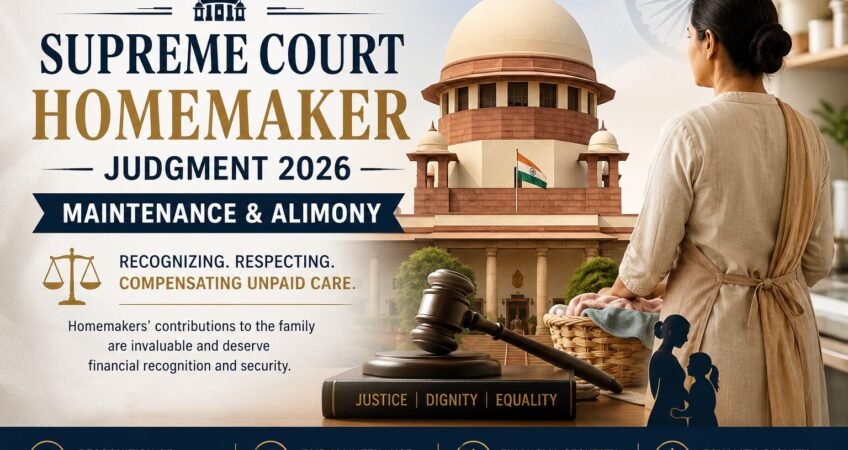
SC Puts ₹30,000/Month Value on Homemakers — What It Means for Your Alimony
By Advocate Karan Dua | Vintage Litigation, New Delhi | Published: June 2026
Two days ago, a ruling from the Supreme Court of India went viral across every major news platform in the country. It wasn’t, on its face, a divorce case. It was a motor accident compensation claim — a homemaker named Reshma had died in a road accident in 2001, and her family had spent twenty-five years fighting for fair compensation.
But buried inside this case is a line of reasoning that every wife — and every husband — currently in a maintenance or alimony dispute in Delhi needs to know about. Because what the Supreme Court did in Shishu Pal @ Shish Ram & Ors. v. Surjeet & Ors. (2026 INSC 634), decided on June 11, 2026, was not just compensate one grieving family. It was put a number — a real, court- ordered minimum number — on what a homemaker’s unpaid work is worth.
₹30,000 per month. Minimum. Rising by 10% every three years. And the Court’s own language describing why: “the housewife contributes to the growth of the human being and the nation… the homemaker builds nation.”
This article explains the ruling, and — more importantly for our clients — exactly how it strengthens the position of wives seeking maintenance and alimony in Delhi’s family courts, and what husbands need to understand about how this changes the conversation.
1. What the Supreme Court Actually Decided
The facts of the case span nearly twenty-five years. Reshma, a homemaker, died in a road accident on the Sirsa–Fatehabad road in Haryana on November 25, 2001, due to rash and negligent driving. Her husband and children filed a claim before the Motor Accident Claims Tribunal, Sirsa, which in December 2003 awarded a mere ₹2.42 lakh — a figure that reflected how poorly Indian compensation law had historically valued a homemaker’s contribution.
The family appealed. The case sat before the Punjab and Haryana High Court for twenty years — the court file was destroyed in a 2011 fire, adding to the delay. In December 2024, the High Court enhanced the award to ₹8.43 lakh. The family, still unsatisfied that this reflected the true value of what they had lost, approached the Supreme Court.
A bench of Justice Sanjay Karol and Justice Nongmeikapam Kotiswar Singh enhanced the compensation dramatically — to ₹62,77,900, almost eight times the High Court’s award. To get there, the Court created an entirely new, standalone head of compensation: “Loss of Domestic Care.”
The Court’s reasoning was direct and, in places, sharply worded. It noted that the existing method of computing a homemaker’s “notional income” using minimum wage benchmarks for unskilled or skilled labour had always undervalued what a homemaker actually does — managing a household is not comparable to hired domestic labour, the Court said, because it blends economic contribution with emotional and managerial responsibility in a way no wage table can capture.
The Court directed that going forward, every Motor Accident Claims Tribunal, High Court, and the Supreme Court itself must add a minimum of ₹30,000 per month under this new head whenever a homemaker’s death is being compensated — to be revised upward by 10% every three years. Critically, the Court clarified this is a floor, not a ceiling: where a homemaker also had paid employment, this amount is added on top of her actual income, not substituted for it.
2. Why a Motor Accident Ruling Matters in Your Divorce Case
At first glance, this might seem like a ruling for personal injury lawyers, not matrimonial lawyers. It is not.
Indian family courts, when computing maintenance under Section 24 (interim) and Section 25 (permanent) of the Hindu Marriage Act, or under Section 144 of the BNSS, have long grappled with exactly the same underlying problem the Supreme Court just addressed: how do you put a number on work that has no payslip?
When a non-working wife seeks maintenance, the husband’s side frequently argues — explicitly or implicitly — that she “contributes nothing financially” and that her claim should be assessed purely against her needs, with little regard for the economic value of what she actually did during the marriage. We addressed this dynamic directly in our earlier article on why a wife’s career choices are not cruelty or desertion. Shishu Pal now provides something that article didn’t have at the time: an explicit, numerical benchmark from the Supreme Court itself, in the context of valuing exactly this kind of unpaid domestic contribution.
This is not a maintenance case. But it is now the single most quotable Supreme Court authority on the economic value of homemaking, and Delhi family courts will not be able to ignore it when the question of a wife’s contribution to the marriage — financial or otherwise — comes up in a maintenance or alimony dispute.
3. The Specific Language That Strengthens a Maintenance Argument
Three aspects of the Court’s reasoning are directly useful in matrimonial litigation, and a well-prepared maintenance application should draw on them.
“It is ironic to describe a homemaker as dependant on earning members, when, in reality the household’s functioning depends substantially on the homemaker.” This single line reframes the entire premise that often underlies a husband’s resistance to maintenance — the assumption that a non-working wife is a financial burden rather than someone whose unpaid labour enabled the household, and often the husband’s own career, to function. Courts assessing maintenance increasingly recognise that a wife who managed the household, raised children, and supported her husband’s working life made a real economic contribution to the marriage — even where she earned no salary.
The explicit rejection of minimum-wage-based valuation. The Court held that pegging a homemaker’s worth to unskilled or skilled labour wage tables fundamentally undervalues the role. This is directly relevant where a husband’s counsel attempts to argue that a wife’s “notional earning capacity” should be assessed at a low, generic figure. The Supreme Court has now said, in the clearest terms available, that this approach misses the true economic weight of domestic work.
The “stand-in” minimum income concept. The Court specifically described ₹30,000/month as a “basic minimum monthly income” stand-in for a homemaker’s contribution in cases where there is no other monetary measure. While this was articulated in the motor accident compensation context, the underlying principle — that ₹30,000/month is the Supreme Court’s own floor valuation of a homemaker’s economic contribution as of June 2026 — is a number that can be cited as persuasive, if not directly binding, authority in maintenance proceedings where a baseline figure for the value of a wife’s domestic contribution becomes relevant.
4. What This Means If You Are a Wife Seeking Maintenance in Delhi
If you have spent years as a homemaker and are now seeking maintenance or permanent alimony in a contested or even mutual divorce, Shishu Pal gives your legal team fresh, high-profile, nationally reported Supreme Court language to draw on when articulating the value of what you contributed to the marriage. This reasoning is particularly useful in cases involving:
A long marriage where you were the primary homemaker and your husband’s counsel is arguing your contribution should be treated as economically negligible.
A case where the court is weighing the duration of the marriage, your age, and your ability to re-enter the workforce against the maintenance quantum being sought — the Supreme Court’s framing of domestic work as a genuine, quantifiable economic contribution supports a stronger baseline claim.
A property or settlement negotiation where your non-financial contributions to the marriage need to be reflected in how assets and ongoing support are structured.
5. What This Means If You Are a Husband Facing a Maintenance Claim
This is not a ruling that should be feared or resisted — it is a ruling that should be understood and factored into a realistic, well-prepared response. The Supreme Court has not created a binding formula that automatically applies to maintenance proceedings — Shishu Pal is a motor accident compensation case, and family courts retain their own established framework (under Section 24, 25 HMA, and the Rajnesh v. Neha (2020) disclosure guidelines) for computing maintenance based on the specific facts of your marriage, your income, and your spouse’s actual needs.
What has changed is the rhetorical and persuasive landscape. Arguments that simply dismiss a homemaker’s contribution as having no economic value are now considerably weaker in front of any judge who has read or heard about this ruling — and given its viral national coverage, most have. A more effective approach for a husband facing a maintenance claim is to engage seriously with the actual financial facts: a full and accurate disclosure of income and assets (as required under Rajnesh v. Neha), a realistic assessment of the wife’s needs and reasonable lifestyle continuity, and a negotiated or litigated outcome grounded in the specific facts of the marriage rather than a dismissive view of domestic contribution.
6. A Word on Where This Ruling Does NOT Directly Apply
It is important to be precise about the limits of this ruling, because overstating its application would do clients a disservice.
Shishu Pal is a Motor Vehicles Act compensation case. It does not create a binding formula that family courts must mechanically apply when computing maintenance under the Hindu Marriage Act or the BNSS. Maintenance computation continues to follow its own established legal framework — factors like both parties’ income, the standard of living during marriage, reasonable needs, and the paying spouse’s capacity remain the core considerations laid down in cases like Rajnesh v. Neha (2020) and subsequent rulings.
What Shishu Pal provides is persuasive authority and powerful framing — not a binding maintenance calculation rule. A competent matrimonial lawyer should use it as part of a broader, well-evidenced argument, not as a standalone formula.
How Vintage Litigation Can Help
Advocate Karan Dua has represented homemaker wives and working husbands across Delhi’s family courts in maintenance, permanent alimony, and settlement negotiations. Whether you are building a maintenance application that needs to properly reflect the value of your contribution to a long marriage, or assessing a maintenance claim against you with a realistic and well-prepared strategy, we can help you understand how this and other recent rulings apply to your specific facts.
Online first consultation. Fully confidential. No commitment required.
📞 Call / WhatsApp: +91-9999483959 📧 Email: Adv.karan.dua67@gmail.com 📍 O-11A, Basement, Jangpura Extension, New Delhi – 110014 ⏰ Monday–Saturday, 9 AM – 6 PM. WhatsApp available after hours.
Frequently Asked Questions
Q1. Does the Supreme Court’s ₹30,000/month homemaker ruling automatically apply to my maintenance case?
Not automatically. Shishu Pal v. Surjeet (2026 INSC 634) is a motor accident compensation ruling, not a maintenance ruling. It does not create a binding formula that family courts must mechanically apply under the Hindu Marriage Act. What it does provide is powerful, nationally reported Supreme Court language affirming the genuine economic value of homemaking — which is persuasive authority your lawyer can draw on when arguing for fair maintenance, particularly where the other side is trying to minimise the value of your domestic contribution.
Q2. Can I cite this ruling directly in my maintenance application?
Yes, your lawyer can reference it as persuasive authority supporting the principle that unpaid domestic work has real, quantifiable economic value — a principle relevant to how courts assess fairness in maintenance and alimony. It should be used alongside, not instead of, the established maintenance framework under Section 24/25 HMA and the financial disclosure requirements set out in Rajnesh v. Neha (2020).
Q3. I’ve been a homemaker for 20 years and never earned a salary. Does that weaken my maintenance claim?
No — and this ruling reinforces exactly why. The Supreme Court explicitly rejected the idea that a homemaker’s lack of salary makes her contribution to the household economically insignificant. Courts in maintenance proceedings already recognise non-financial contributions — managing the household, raising children, supporting a spouse’s career — as relevant factors, and this ruling provides additional, high-profile support for that principle.
Q4. My husband’s lawyer says I have no claim because I “never worked.” Is that a valid argument?
It is an argument frequently raised, but it does not reflect the current legal position. Both existing maintenance law and the reasoning in Shishu Pal recognise that homemaking is a genuine economic contribution to a marriage, even without a salary. A well-prepared maintenance application should directly address and counter this framing with evidence of your actual contributions during the marriage.
Q5. How is maintenance actually calculated in Delhi family courts?
Maintenance is computed based on both parties’ income and assets (with full disclosure mandated under Rajnesh v. Neha, 2020), the standard of living during the marriage, the duration of the marriage, the claimant’s reasonable needs, age, health, and earning capacity, and the paying spouse’s actual capacity to pay. There is no single fixed formula, but Delhi courts generally apply a structured, fact-specific analysis. Read our detailed guide on how much you have to pay or can claim for a full breakdown.
Q6. Does this ruling affect maintenance for working wives too?
The Court specifically clarified that where a homemaker also has paid employment, the “loss of domestic care” component is added on top of, not in place of, her actual income. By analogy, this reinforces that domestic contribution and income-earning are not mutually exclusive considerations — a working wife who also manages the household can point to both her income and her domestic contribution when maintenance is being assessed.
Q7. My wife wants maintenance but she has a degree and could theoretically work. Does this ruling weaken my position?
This ruling speaks to the value of work already performed during the marriage, not to the separate legal question of whether a financially capable spouse should be expected to seek employment going forward. Courts already consider earning capacity, education, age, and the time gap in employment when assessing maintenance — these factors remain independently relevant and are not displaced by Shishu Pal. A realistic strategy addresses both the value of past contribution and the genuine question of future earning capacity.
Q8. Is ₹30,000/month now the “minimum” maintenance I should expect in Delhi?
No. ₹30,000/month was the minimum notional monthly income fixed for computing motor accident compensation under a specific new head — it is not a maintenance benchmark and should not be treated as a floor or ceiling for what maintenance should be in a divorce case. Maintenance is calculated based on the specific financial facts of your marriage, not a fixed figure borrowed from an unrelated area of law.
Q9. How long did this case take, and does that matter for my own case?
The underlying accident occurred in 2001; the Supreme Court’s final ruling came in 2026 — a 25-year journey, caused partly by a court file destroyed in a fire and partly by years of pendency at the High Court level. While this delay is specific to motor accident litigation (not matrimonial proceedings, which generally move faster), it is a useful reminder of why early, well-documented filings matter — the Court itself noted average pendency of 6–8 years across the cases it reviewed and directed courts to prioritise long-pending matters. In matrimonial matters, prompt and properly documented filing similarly protects your position from unnecessary delay.
Q10. Where can I read the full Supreme Court judgment?
The judgment is publicly available as Shishu Pal @ Shish Ram & Ors. v. Surjeet & Ors. (2026 INSC 634), decided June 11, 2026, by a bench of Justice Sanjay Karol and Justice Nongmeikapam Kotiswar Singh. If you would like to understand how its reasoning specifically applies to your maintenance or alimony situation, a consultation with a matrimonial lawyer familiar with both this ruling and the established maintenance framework is the most reliable next step.
Adv. Karan Dua — Advocate, Delhi High Court | Matrimonial & Family Law Adv. Karan Dua is a Delhi-based advocate specialising in maintenance, permanent alimony, contested and mutual divorce, and complex matrimonial settlement negotiations. He practises before the Delhi High Court and family courts across the NCR. Learn more about Vintage Litigation or get in touch.