
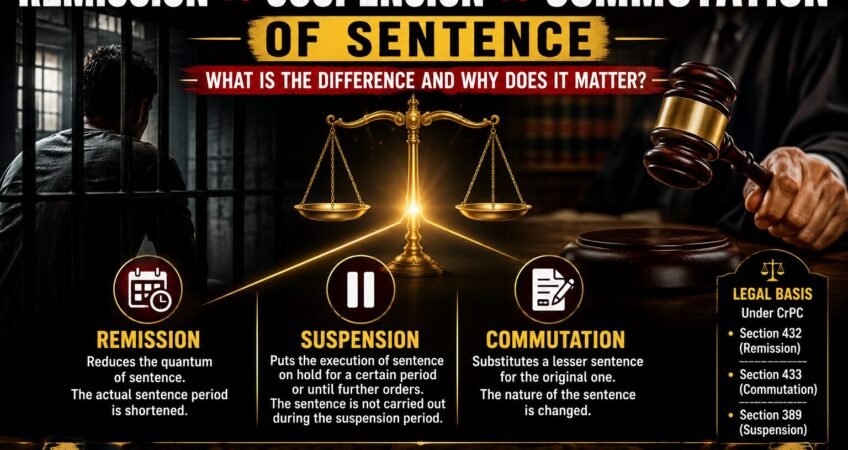
Remission, Suspension & Commutation of Sentence — What Is the Difference and Why Does It Matter?
When a court sentences a person for a crime, that is not always the final word. The law gives the government certain powers to change, reduce, or pause a sentence — even after the court has passed its order. These powers are called remission, suspension, and commutation. Many people — including law students and practising lawyers — confuse these three terms. This article breaks each one down in plain language, explains the legal provisions behind them, compares them side by side, and answers the most common questions.
Understanding the big picture — executive clemency
Before diving into the differences, it helps to understand what all three have in common: they are all forms of executive clemency — meaning they are exercised by the executive branch of government (the President, the Governor, or the State/Central Government), not by the courts.
The legal authority for these powers comes from two sources in India. The constitutional source is Articles 72 and 161, which give the President and the Governor the power to grant pardons, reprieves, respites, remissions, and commutations. The statutory source is Sections 432–435 of the CrPC (now Sections 473–476 of the BNSS, 2023), which empower the appropriate government to suspend or remit sentences.
Reduces the remaining portion of the sentence. The conviction stays intact.
Sentence shortened
Temporarily postpones the execution of sentence. The prisoner is not released permanently.
Sentence paused
Substitutes a heavier punishment with a lesser one — e.g., death sentence changed to life imprisonment.
Sentence substituted
Wipes out both conviction and sentence completely. The person is treated as if never convicted.
Conviction erased
Remission of sentence — a detailed look
Remission means reducing the amount of sentence a convicted person still has to serve. If someone is sentenced to 10 years in prison and the government grants remission of 3 years, they effectively serve only 7 years. Importantly, the conviction itself remains on record — only the quantum of punishment is reduced.
Key features of remission
- It can be full (entire remaining sentence wiped out) or partial (only a portion reduced)
- The government may attach conditions to the remission order
- If conditions are violated, the remission can be cancelled and the person must serve the remaining sentence
- Under Section 432(2) CrPC, in cases of life imprisonment, the government must consult the Presiding Judge before granting remission
- Re-arrest without a formal cancellation order and court remand has been held unconstitutional (violative of Article 21)
Suspension of sentence — a detailed look
Suspension means the execution of the sentence is put on hold for a period of time. The person is not freed permanently — the sentence is merely paused. This is commonly used when a prisoner needs temporary relief for medical treatment, family emergencies, or pending appeals.
How suspension differs from bail
Many people confuse suspension of sentence with bail. Bail is granted before or during trial — it deals with custody before conviction. Suspension of sentence operates after conviction — it temporarily pauses the running of a sentence that has already been imposed by the court.
Key features of suspension
- It is temporary in nature — the sentence resumes after the suspension period ends
- The government can revoke the suspension at any time
- Unlike remission, it does not reduce the total sentence — the prisoner still has to complete it
- Suspension can be granted with or without conditions
- Courts also have the power to suspend sentences under Section 389 CrPC (Section 430 BNSS) during pendency of appeal
Commutation of sentence — a detailed look
Commutation means replacing a heavier punishment with a lesser one. It does not reduce the sentence — it changes the nature of the punishment entirely. The most common example in Indian law is the commutation of a death sentence to life imprisonment. The conviction stands, and the person still serves a punishment — just a different, less severe one.
Key features of commutation
- The original punishment is replaced — not reduced, not paused
- Under Section 433 CrPC (Section 474 BNSS), death sentence can be commuted to life imprisonment; life imprisonment can be commuted to rigorous imprisonment of up to 14 years
- The power is concurrent — both the President (Art. 72) and the Governor (Art. 161) can exercise it
- In death sentence cases, the appropriate government’s recommendation under Section 435 CrPC is required
- Commutation cannot be challenged as a matter of right — it is a discretionary power
Side-by-side comparison table
| Point of difference | Remission | Suspension | Commutation |
|---|---|---|---|
| Meaning | Reduces remaining sentence | Pauses the sentence temporarily | Substitutes sentence with a lesser one |
| Effect on conviction | Conviction stands | Conviction stands | Conviction stands |
| Effect on sentence | Reduced / cancelled | Temporarily stopped | Changed to lesser punishment |
| Duration | Permanent (until cancelled) | Temporary | Permanent substitution |
| CrPC provision | Section 432 | Section 432 | Section 433 |
| BNSS 2023 provision | Section 473 | Section 473 | Section 474 |
| Constitutional source | Art. 72 / 161 | Not under Art. 72/161 | Art. 72 / 161 |
| Can be cancelled? | Yes, if conditions violated | Yes, at any time | Generally no |
| Who grants it? | Appropriate Government | Appropriate Government / Court | President / Governor / Govt. |
| Example | 10-year sentence reduced to 7 years | Sentence paused for 3 months for surgery | Death sentence → Life imprisonment |
The constitutional dimension — Articles 72 and 161
It is important to know that the power to grant clemency under Articles 72 and 161 of the Constitution is wider than the statutory power under CrPC/BNSS. The President and Governor can exercise these powers even in cases where the courts cannot interfere. However, the Supreme Court has held that these powers are not absolute — they must be exercised on the advice of the Council of Ministers, and the decision can be judicially reviewed if it is arbitrary, irrational, or based on irrelevant considerations.
Difference between Art. 72 and Art. 161
- Article 72 vests the power in the President — applies to offences against Union laws and death sentence cases
- Article 161 vests the power in the Governor — applies to offences against State laws
- Both powers are exercised on the advice of the respective Council of Ministers
How the appropriate government is determined
Under Section 432(7) CrPC (Section 473(7) BNSS), the “appropriate government” is determined as follows:
- If the sentence is for an offence against a law of the Union — the Central Government
- If the sentence is for an offence against a law of a State — that State Government
- If the offender is sentenced to imprisonment in a State other than where the offence was committed — that State Government (where the prisoner is confined)
Frequently asked questions
What is the main difference between remission and commutation?
Remission reduces the remaining portion of the same type of sentence — the nature of punishment stays the same, just less of it is served. Commutation changes the nature of the punishment altogether — for example, replacing a death sentence with life imprisonment. In remission the sentence is shortened; in commutation the sentence is substituted.
Does remission of sentence erase the conviction?
No. Remission only affects the remaining punishment — it does not wipe out the conviction. The person’s criminal record still shows the conviction. Only a pardon (under Articles 72 or 161 of the Constitution) can erase the conviction along with the sentence.
Can suspension of sentence be cancelled?