
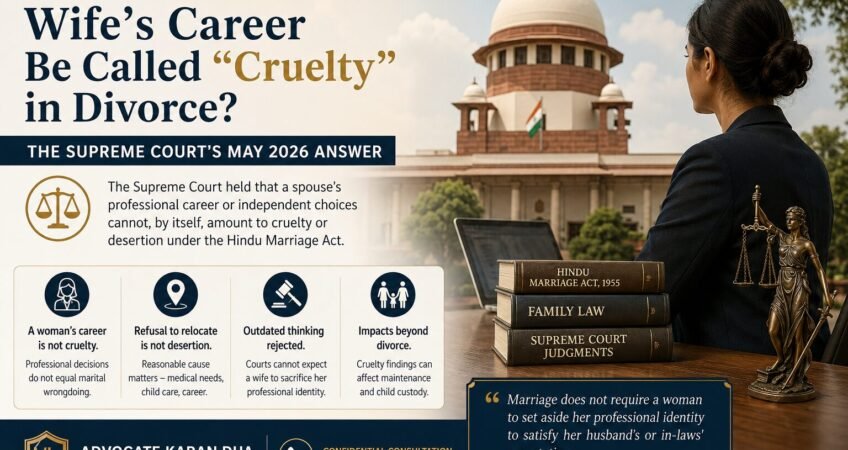
Can Your Wife’s Career Be Called “Cruelty” in a Divorce?
By Advocate Karan Dua | Vintage Litigation, New Delhi | Published: August 2026
A version of this question comes up in almost every consultation where a husband is building a cruelty or desertion case: “She put her career first — doesn’t that count against her?” In May 2026, the Supreme Court answered this more directly than it ever has before, and the answer will change how a lot of pending cases get argued.
The Case That Prompted the Ruling
A dentist married an Army officer in 2009. She initially paused her practice to join him at his posting in Kargil. After she became pregnant and their daughter developed serious medical complications, she moved to Ahmedabad — where better treatment was available — and opened her own dental clinic there.
The husband later sought divorce, arguing that her decision to build a practice without deferring to him and his family amounted to cruelty and desertion. In 2022, the family court agreed and granted him the divorce on those grounds. The Gujarat High Court upheld that reasoning in 2024. The wife wasn’t contesting the divorce itself by the time the matter reached the Supreme Court — she was fighting to get the cruelty and desertion findings struck from the record, since a marriage this long dead wasn’t in dispute; what she was fighting was being formally, legally branded as the one at fault for building a career.
What the Supreme Court Actually Said
The bench — Justices Vikram Nath and Sandeep Mehta — didn’t just overturn the lower courts’ reasoning, it directly criticised it. The Court held that treating a qualified professional’s decision to practise her profession as cruelty reflects outdated, one-sided thinking that has no place in how courts should read marriage today. Marriage, the bench made clear, doesn’t require a woman to set aside her professional identity to satisfy her husband’s or in-laws’ expectations of where and how she should live.
Importantly, the Court did not reverse the divorce itself — the marriage had clearly broken down over more than a decade of separation, and the husband had since remarried. What the Court did was strike the specific findings of cruelty and desertion from the decree, and it also declined to allow the husband to pursue further prosecution against his wife on top of everything else, seeing that request for what it was.
Why This Matters Beyond This One Case
If your matter involves a spouse’s career, work travel, refusal to relocate for a job, or professional decisions made without the other side’s approval, this ruling directly affects how much weight those facts can carry in a cruelty argument going forward.
Here’s what it changes in practice:
- “She didn’t consult me before opening her practice” is not, by itself, cruelty. Courts are now on clear notice that a spouse’s independent professional decision-making isn’t inherently a marital wrong.
- Refusing to relocate for a spouse’s job posting isn’t automatically desertion, particularly where there’s a reasonable cause — medical needs, a child’s care, career continuity — behind the decision to stay put.
- Lower courts that lean on “traditional wifely duty” language are now more exposed on appeal. This judgment gives appellate counsel a strong, recent citation to challenge that reasoning directly.
- It cuts both ways. The same logic applies if a husband’s career decisions — relocation for work, long postings, demanding hours — are being framed as cruelty or desertion against him. The Court’s core reasoning is about professional autonomy within marriage, not about which spouse benefits.
What This Doesn’t Mean
This ruling doesn’t mean career-related facts are irrelevant to a case — it means they can’t be treated as cruelty in isolation, without more. If a spouse’s professional choices are genuinely tied to abandonment of the marriage, financial neglect, or a documented pattern of desertion beyond simply “working” or “relocating,” those underlying facts still matter. What changed is that a court can no longer treat “she prioritised her career” as a self-evident wrong requiring no further proof of harm.
Similarly, cruelty and desertion still remain valid, well-established grounds for divorce under the Hindu Marriage Act — this judgment narrows what counts as evidence of them, it doesn’t eliminate the grounds themselves.
What to Do If This Applies to Your Case
If you’re the spouse whose career is being framed as cruelty: don’t treat this as something you can raise for the first time at final arguments. Get this judgment on record early — at the written statement stage if you’re the respondent, or through an application if the matter is already mid-trial. The specificity of your professional decisions (why you moved, why you stayed, what medical or child-related reasons applied) still matters; the judgment protects the principle, but a well-documented factual record protects your case.
If you’re building a cruelty or desertion case and career facts were part of your strategy: this is the moment to revisit that strategy with your lawyer. Career-related facts aren’t off the table entirely, but they now need to be tied to something more concrete — financial abandonment, a documented pattern of neglect, or facts beyond the profession itself — to hold up.
If custody or maintenance is also part of your matter: this ruling has a quieter but real effect there too. Courts have historically let cruelty findings colour how they view a parent’s fitness in custody disputes or a spouse’s conduct in maintenance proceedings. Getting an unfair cruelty finding struck from the record, as this wife did, can matter well beyond the divorce decree itself.
A Realistic Example
A wife who works night shifts as a hospital resident is accused by her husband of “neglecting the household” and “prioritising her career” in a contested divorce filed on cruelty grounds. Before this ruling, that framing alone might have carried real weight with a sympathetic family court. After it, her lawyer can point directly to this Supreme Court reasoning to argue that her professional commitments, on their own, don’t constitute cruelty — and can push the burden back onto the husband to show something more concrete than her work schedule.
Frequently Asked Questions
1. Does this ruling mean my spouse’s career can never be used in a cruelty case?
No. It means career decisions alone, without more, don’t automatically amount to cruelty or desertion. If there are additional facts — financial neglect, abandonment, a documented pattern of harm — those still need to be argued and proven separately.
2. My divorce was already finalised on cruelty/desertion grounds partly because of my career. Can I get that changed now?
Possibly, depending on your case’s procedural stage and whether you’re within any applicable appeal or review timelines. This is worth a direct conversation with a lawyer about your specific order and dates — it isn’t a blanket right to reopen a closed matter.
3. Does this affect only wives, or can husbands use this reasoning too?
The Court’s underlying reasoning is about professional autonomy within marriage generally, not specific to gender. If a husband’s career decisions are being framed as cruelty or desertion against him, this judgment is equally relevant to his defence.
4. If my spouse refused to relocate for my job, is that still desertion?
Not automatically. The Court’s reasoning suggests a reasonable cause — medical needs, a child’s treatment, career continuity — can justify staying put without it amounting to desertion. Whether your specific facts qualify as “reasonable cause” is a case-specific legal question.
5. Can this judgment help in a maintenance or custody dispute, not just divorce?
Indirectly, yes. Cruelty findings can influence how courts approach maintenance and custody. If an unfair cruelty finding is affecting either, raising this judgment as part of your broader case strategy is worth discussing with your lawyer.
Disclaimer: This article is for general informational purposes only and does not constitute legal advice. Every case is fact-specific — consult a qualified advocate regarding your specific circumstances before taking any legal action.
Speak to Advocate Karan Dua — confidential first consultation →