
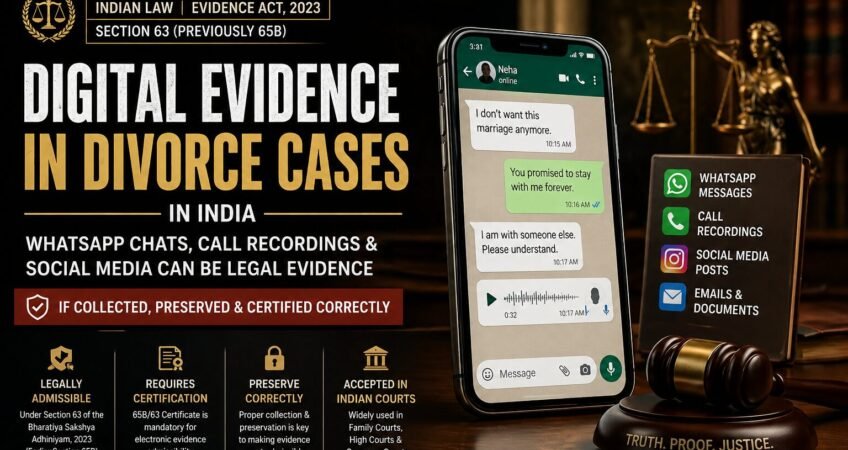
Your Phone Is Your Best Lawyer: How to Legally Collect Evidence for Divorce in India
A comprehensive legal guide on what digital evidence is admissible in Indian divorce courts, how to preserve it correctly, and the critical mistakes that could get your evidence thrown out — or worse, get you charged with an offence.
Why Your Phone Matters More Than Any Witness
Divorce litigation in India has changed fundamentally over the past decade. Courts once relied almost entirely on oral testimony — neighbours, relatives, and household staff taking the stand to describe what they witnessed behind closed doors. Today, a screenshot, a WhatsApp chat, a call log, or a bank statement downloaded on your phone can carry far greater evidentiary weight than any human witness.
The reason is simple: digital evidence, when properly preserved, is objective, time-stamped, and extremely difficult to fabricate convincingly. Indian courts — including the Delhi High Court and the Supreme Court — have increasingly accepted electronic evidence in matrimonial disputes involving cruelty, adultery, desertion, and financial fraud.
Digital evidence in Indian civil proceedings is governed by Section 65B of the Indian Evidence Act, 1872 (now mirrored in the Bharatiya Sakshya Adhiniyam, 2023). Without a proper Section 65B certificate, electronic evidence is inadmissible — no matter how damning it appears.
What Digital Evidence Is Legally Admissible in India
Under Indian law, electronic records are admissible as evidence only when they satisfy the conditions laid down under Section 65B, Evidence Act. The Supreme Court’s landmark ruling in Anvar P.V. v. P.K. Basheer (2014) and the subsequent clarification in Arjun Panditrao Khotkar v. Kailash Kushanrao Goratyal (2020) make it mandatory to produce a certificate from a competent authority confirming the electronic record’s authenticity.
The Section 65B Certificate — Non-Negotiable
This certificate must confirm:
- The computer from which the evidence was produced was in regular use during the relevant period
- The information was fed into the computer in the ordinary course of activities
- The computer was operating properly (or, if not, did not affect the output)
- The electronic record is a reproduction of the original information
Without this certificate, a judge cannot admit your WhatsApp chats, call logs, emails, or social media screenshots — even if they are genuine. Obtain this certificate at the time of filing, not as an afterthought.
Types of Evidence You Can Legally Collect
Your smartphone is effectively a personal evidence locker. Here is what can be lawfully preserved and used:
Texts admitting cruelty, threats, admissions of affairs, or abusive language. Export chats as .txt with media for a full backup.
Patterns of blocked calls, calls to third parties at odd hours, call duration history — all obtainable from your telecom provider via RTI or court order.
Financial concealment, admission of assets or liabilities, communications with a third party during the marriage.
Images showing injuries, property, cohabitation with a third party. Metadata (date, time, GPS) is critical — do not edit or crop.
Bank statements, UPI transactions, credit card bills showing hidden accounts, income, or lifestyle inconsistencies.
Public posts, stories, or check-ins that contradict claims made in court — e.g., claiming poverty while posting luxury holidays.
Medical Records via Phone
If you have sustained injuries due to domestic violence, photograph and document injuries immediately with timestamps. Additionally, keep digital copies of doctor’s reports, hospital discharge summaries, and pharmacy bills — these, combined with Section 498A IPC (now Section 85, BNS 2023), form some of the strongest evidence in cruelty-based divorce petitions.
How to Preserve Digital Evidence Correctly
Collection is only half the battle — chain of custody and proper preservation determine whether your evidence survives cross-examination. Follow this protocol:
Step 1: Do Not Alter the Original
- Never edit, crop, or filter photographs or screenshots before preserving them.
- Do not delete and re-screenshot — metadata changes and the original timestamp is lost.
- Keep the original device; do not factory reset or upgrade the OS until the case concludes.
Step 2: Create Multiple Backups Immediately
- Back up to two separate cloud accounts (e.g., Google Drive, iCloud) and one physical external drive.
- For WhatsApp, useSettings → Chats → Chat Backupand also email the chat export to yourself.
- Use the “Export Chat” function (without deleting media) — this creates a .zip with all attachments.
Step 3: Get the Evidence Notarised
Take printed screenshots and a notary’s declaration that the printout corresponds to the digital original. While not a substitute for a Section 65B certificate, a notarised printout adds weight and helps explain the evidence to the judge during interim hearings.
Step 4: Obtain the Section 65B Certificate
Work with your advocate to draft the certificate. If the evidence is from a third-party platform (e.g., WhatsApp servers), your lawyer can file an application before the court directing the platform or your telecom provider to furnish the certificate.
Delhi Family Courts routinely accept WhatsApp chats in matrimonial matters — but judges scrutinise whether the producing party owned the phone and had lawful access to the account. Always be prepared to testify on oath about how the evidence came into your possession.
Evidence That Can Land You in Legal Trouble
There is a fine but critical line between lawful evidence gathering and illegal surveillance. Cross it, and you may find yourself facing criminal charges even as the aggrieved party.
What You Must Never Do
- Install spyware or tracking apps on a spouse’s phone without consent. This violates Section 66E, IT Act (privacy violation) and Section 72, IT Act (breach of confidentiality).
- Access a spouse’s email or social media account without permission. Unauthorised access to a computer resource is an offence under Section 66, IT Act 2000.
- Record a phone call without the other party’s knowledge in a private conversation — this may constitute illegal interception under Section 5, Indian Telegraph Act.
- Use a private investigator to plant evidence. Evidence procured through unlawful means is inadmissible and may expose you and the PI to criminal liability.
- Screenshot a password-protected WhatsApp account on another’s phone by accessing it without consent — the key test is whether you had lawful access.
I have seen cases collapse — and respondents turn into complainants — because a spouse installed a spy app thinking it would help their case. Courts take a dim view of illegally obtained evidence. If you are unsure whether your method of collection is lawful, call a lawyer first.
The “Voluntary Disclosure” Exception
Evidence shared voluntarily by the other party — forwarded messages, publicly visible social media posts, joint email accounts — is generally lawful to use, as no interception or hacking occurred. The test is consent and lawful access, not just who sent the message.
How Courts Use Digital Evidence in Divorce Proceedings
Indian family courts use digital evidence across a range of divorce grounds and ancillary proceedings:
Cruelty (Section 13(1)(ia), Hindu Marriage Act)
Abusive WhatsApp messages, threatening voice notes, and emails are routinely relied upon to establish mental cruelty. A single message threatening violence or making caste-based or sexual slurs has been held to constitute cruelty by several High Courts.
Adultery
While adultery is no longer a criminal offence post Joseph Shine v. Union of India (2018), it remains a ground for divorce. Location data, photographs, hotel booking confirmations, and messages can establish the factum of adultery in civil proceedings.
Maintenance & Alimony Quantum
This is perhaps where digital evidence is most decisive. Screenshots of UPI payments, Instagram posts showing luxury travel, LinkedIn profiles contradicting claimed income, and bank statements proving undisclosed assets can dramatically alter the maintenance awarded under Section 24/25, HMA or Section 125, CrPC.
Child Custody
Messages threatening harm to a child, evidence of substance abuse, or communication establishing parental alienation are increasingly placed before Family Courts in custody disputes. The child’s welfare being the paramount consideration, judges take such digital evidence seriously.
Frequently Asked Questions
Yes — WhatsApp messages are admissible as electronic evidence provided they are accompanied by a Section 65B certificate under the Indian Evidence Act (or the Bharatiya Sakshya Adhiniyam 2023). Courts in Delhi and across India have accepted WhatsApp chats in matrimonial proceedings, particularly in cruelty cases. However, you must be able to prove that you had lawful access to the phone or account from which the messages were retrieved.
Is it legal to record my spouse without their knowledge in India?
Recording a private conversation without consent can attract liability under the Indian Telegraph Act and the IT Act. That said, if you are a party to the conversation and record it on your own phone for self-protection, this occupies a grey zone that Indian courts have not definitively resolved. The safest approach is to consult a lawyer before recording any private communication.
What is a Section 65B certificate and why do I need it?
A Section 65B certificate is a mandatory document certifying that electronic evidence (a screenshot, email, or call record) has been produced from a computer that was in regular use, operated properly, and generated the record in the ordinary course of activity. Without this certificate — as mandated by the Supreme Court in Arjun Panditrao Khotkar (2020) — electronic evidence simply cannot be admitted in court.
Can I use my spouse’s deleted messages as evidence?
Recovering deleted messages from your own phone is generally lawful — forensic recovery of data from your own device does not constitute hacking. However, recovering deleted data from your spouse’s phone or accounts without consent could amount to unauthorised access under the IT Act. Always use a court-commissioned forensic expert if the device belongs to the other party.
Yes. Public social media posts — Facebook, Instagram, X (Twitter) — are treated as publicly accessible electronic records. A parent’s posts showing alcohol abuse, reckless behaviour, or undermining of the other parent’s relationship with the child can be placed before the Family Court. Even in custody mediation, such posts can influence the outcome significantly.
What should I do if I suspect my spouse is hiding assets?
Do not attempt to access their accounts illegally. Instead, your advocate can file an application before the Family Court directing your spouse to produce financial documents, or can apply to the court to issue notices to banks, the Income Tax Department, or the MCA (for business interests) under the appropriate provisions. Courts have broad powers to compel financial disclosure in matrimonial proceedings.
Is evidence gathered by a private detective admissible in Indian courts?