Can you travel abroad during divorce case in India legal position explained with court, passport and airplane concept

Can You Travel Abroad During Divorce Case in India? Legal Position Explained

Divorce proceedings are often emotionally and legally complex, and many individuals find themselves unsure about what they can and cannot do while a case is pending in court. One common concern that frequently arises is whether a person can travel abroad during the pendency of a divorce case in India. This question becomes even more […]
Continue Reading
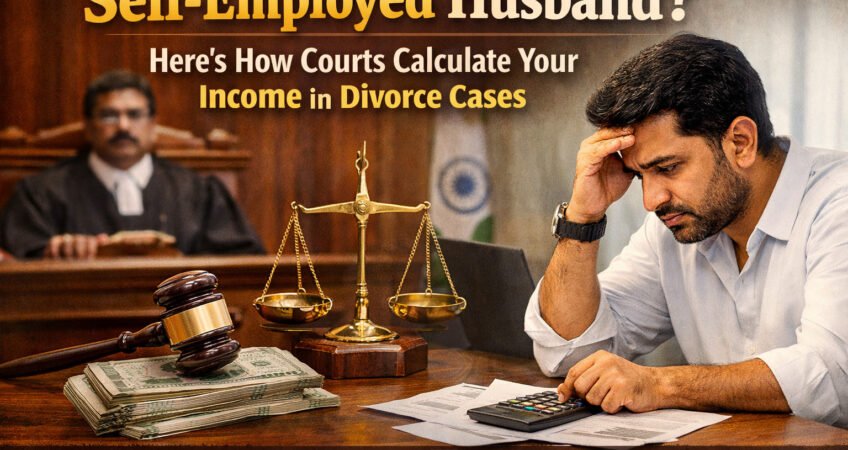
Self-employed husband calculating income with documents while Indian court judge, gavel, and justice scale appear in background representing divorce income assessment

Self-Employed Husband? Here’s How Courts Calculate Your Income in Divorce Cases ⚖️

In divorce and maintenance cases, determining the income of a self-employed husband is often more complex than assessing that of a salaried individual. Unlike fixed monthly salaries, self-employment income can vary significantly and may not always be transparently documented. However, Indian courts have developed practical methods to assess the real financial position of a self-employed […]
Continue Reading
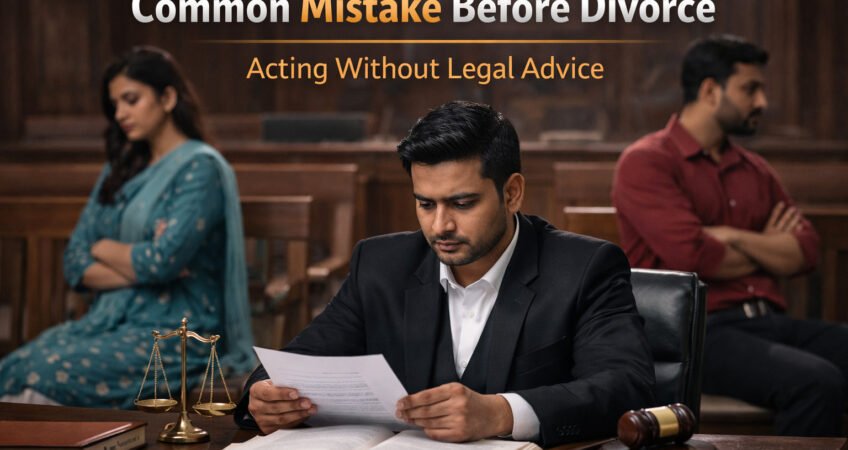
Common mistake before divorce in India showing lawyer reviewing case with couple in courtroom setting

The Biggest Mistake People Make Before Divorce – And How to Avoid It

Introduction Divorce is one of the most important legal and personal decisions a person can make. It not only affects your relationship but also your financial stability, mental peace, and, in many cases, the future of your children. Despite its seriousness, many people approach divorce in a reactive and emotional manner, without fully understanding the […]
Continue Reading
In family court proceedings, parties are generally expected to cooperate with the process by answering questions truthfully and providing relevant information.

Can You Refuse to Answer Questions in Family Court? Legal Position Explained

In family court proceedings, parties are generally expected to cooperate with the process by answering questions truthfully and providing relevant information. The purpose of such questioning is to help the court understand the facts of the case and arrive at a fair decision. Therefore, as a general rule, a person cannot simply refuse to answer […]
Continue Reading
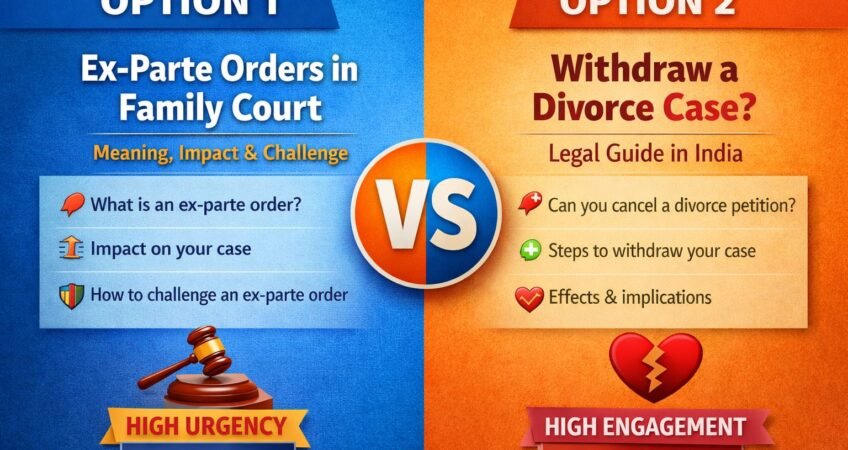
Comparison infographic showing Ex-Parte Orders in Family Court vs Withdrawing a Divorce Case in India with key legal points, symbols of justice, and highlighted urgency vs engagement themes

What Evidence is NOT Accepted in Family Court? (India Guide)

In family court matters such as divorce, maintenance, or child custody, evidence plays a crucial role. However, many people assume that anything can be submitted as proof. That is not correct. Courts follow specific legal principles to determine whether evidence is admissible. Submitting improper or inadmissible evidence can weaken your case, even if your claims […]
Continue Reading
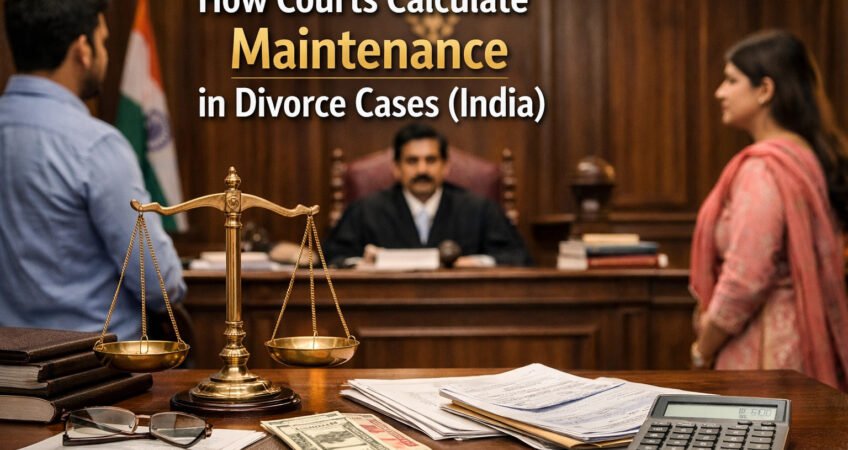
Indian court scene illustrating how maintenance is calculated in divorce cases based on income, expenses, and financial documents

How Courts Calculate Maintenance in Divorce Cases (India):- Complete Legal Guide

Maintenance is one of the most important and often misunderstood aspects of divorce proceedings. Many people believe there is a fixed formula for calculating maintenance—but in reality, courts in India follow a case-by-case approach to ensure fairness and dignity for both parties. This article explains how courts determine maintenance, the key factors involved, and what […]
Continue Reading

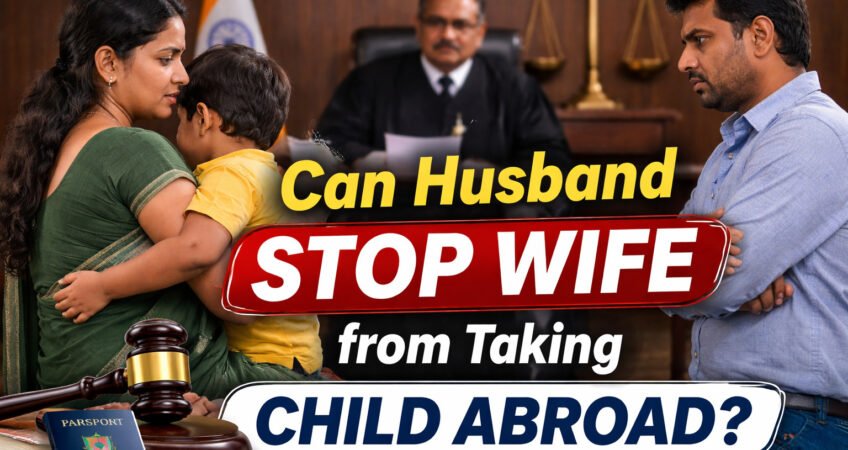
Can a husband stop a wife from taking a child abroad?

Disputes relating to a child’s relocation or travel abroad are increasingly common in matrimonial conflicts. Such situations often arise during divorce proceedings, custody battles, or even after separation. Indian courts approach these matters with a clear and consistent principle — the welfare and best interest of the child is paramount above all else. This article […]
Continue Reading
Maintenance Under Section 125 CrPC in Indian family court with judge hearing maintenance case

Maintenance Under Section 125 CrPC – Complete Guide

Maintenance is a crucial legal right designed to prevent destitution and ensure financial support for dependents. In India, one of the most widely used provisions for maintenance is Section 125 of the Code of Criminal Procedure (CrPC). It provides a quick and effective remedy for wives, children, and parents who are unable to maintain themselves. […]
Continue Reading
Illustration of Indian court and couple representing extramarital affairs and divorce law in India

Extramarital Affairs and Divorce Law in India – What Courts Say

Marriage in India is not only a social institution but also a legal bond governed by various personal laws. One of the most sensitive and commonly cited reasons for marital breakdown is an extramarital affair. While such situations are emotionally challenging, they also raise important legal questions—especially when it comes to divorce. Understanding how Indian […]
Continue Reading

Divorce proceedings are often emotionally and legally complex, and many individuals find themselves unsure about what they can and cannot do while a case is pending in court. One common concern that frequently arises is whether a person can travel abroad during the pendency of a divorce case in India. This question becomes even more important in today’s global environment, where work commitments, family responsibilities, and personal reasons often require international travel.

The simple answer is that travelling abroad during a divorce case in India is not automatically prohibited. However, the legal position depends on several factors, including the nature of the case, any orders passed by the court, and the conduct of the parties involved. Understanding these nuances is essential to avoid legal complications.

In Indian law, there is no blanket restriction that prevents a husband or wife from leaving the country simply because a divorce petition has been filed. Divorce proceedings, whether under the Hindu Marriage Act, Special Marriage Act, or other personal laws, do not in themselves curtail an individual’s fundamental right to travel. However, this right is not absolute. Courts have the authority to impose restrictions if they believe that a party may evade legal proceedings or fail to comply with court directions.

One of the most important factors that determines whether you can travel abroad is whether the court has passed any specific order restricting your movement. In some cases, especially those involving child custody, maintenance disputes, or allegations such as domestic violence or cruelty, the court may impose conditions to ensure that justice is not obstructed. For instance, if the court believes that a party may not return to India or may attempt to delay proceedings, it can direct that the individual should not leave the country without prior permission.

In situations where no such restriction exists, travelling abroad is generally permissible. However, it is always advisable to inform your lawyer and, in certain cases, the court about your travel plans. This demonstrates transparency and good faith, which courts tend to appreciate. If your presence is required for a scheduled hearing, failing to appear without valid justification could lead to adverse consequences, such as the case proceeding ex-parte or even the issuance of a warrant in extreme situations.

Another important aspect to consider is whether there are any parallel criminal proceedings involved. In many matrimonial disputes in India, cases under Section 498A IPC, domestic violence laws, or maintenance claims may run alongside the divorce petition. In such scenarios, the legal scrutiny becomes stricter. If a criminal case is pending and the court has issued bail with conditions, those conditions may include restrictions on travel. Violating such conditions can lead to cancellation of bail and serious legal repercussions.

Child custody matters add another layer of complexity. If the dispute involves minor children, courts are particularly cautious. A parent cannot simply take the child abroad without the consent of the other parent or permission from the court. Doing so may be viewed as parental abduction and can significantly harm one’s case. Even if the travel is temporary, prior approval is usually necessary to ensure that the child’s welfare is protected, which remains the paramount consideration for Indian courts.

In some cases, courts may allow travel abroad but impose certain safeguards. These may include submitting a detailed travel itinerary, providing an undertaking to return within a specified time, depositing security, or sharing contact details while abroad. Such conditions are designed to balance the individual’s freedom with the need to ensure that the legal process is not compromised.

It is also important to understand the practical side of things. Divorce cases in India can take time, and multiple hearings may be scheduled over months or even years. If you have professional obligations, such as an overseas job or business commitments, courts are generally willing to accommodate genuine requests. Judges often take a pragmatic approach, especially when the applicant shows a willingness to cooperate and comply with all legal requirements.

On the other hand, if a party attempts to misuse the liberty of travel to delay proceedings or avoid compliance with court orders, the consequences can be serious. Courts have wide powers to ensure justice, including issuing non-bailable warrants, impounding passports, or proceeding with the case in the absence of the defaulting party. Therefore, honesty and compliance are crucial.

From a legal strategy perspective, seeking prior permission from the court before travelling abroad is always the safest approach, even if there is no explicit restriction. Filing a simple application through your lawyer stating the purpose, duration, and details of travel can help avoid future disputes. It also protects you from allegations by the opposing party that you are trying to evade the legal process.

In conclusion, travelling abroad during a divorce case in India is not inherently illegal, but it is subject to legal scrutiny depending on the facts of the case. The absence of a specific court order generally allows travel, but factors such as pending criminal cases, child custody issues, and compliance with court proceedings play a significant role. The key lies in maintaining transparency, respecting court directions, and seeking legal guidance before making any decision.

Divorce litigation is as much about legal rights as it is about responsible conduct. By taking informed steps and acting in good faith, individuals can manage both their personal commitments and legal obligations without unnecessary complications.

FAQs:

Can I travel abroad while my divorce case is ongoing in India?

Yes, in most cases you can travel abroad during a pending divorce case, as there is no automatic legal restriction. However, this is subject to whether the court has passed any specific order restricting your travel. If no such order exists, you are generally free to travel, but it is advisable to inform your lawyer or seek permission from the court to avoid complications.

Do I need court permission before travelling abroad?

Court permission is not always mandatory, but it is strongly recommended. Seeking prior approval shows good faith and helps prevent the opposite party from raising objections later. If your presence is required for a hearing, the court may ask you to adjust your travel dates or grant permission with conditions.

What happens if I travel abroad without informing the court?

If you travel without informing the court and miss a scheduled hearing, the court may proceed ex-parte (in your absence) or take strict action such as issuing a warrant in serious cases. It can also negatively impact your credibility in the case.

Can the court stop me from leaving India during divorce proceedings?

Yes, the court has the power to restrict your travel if it believes that you may not return or may delay the proceedings. In such cases, the court may pass an order requiring you to seek permission before travelling or even impound your passport in extreme situations.

Can I travel abroad if there is also a 498A or domestic violence case pending?

If there are parallel criminal proceedings, such as under Section 498A IPC or domestic violence laws, travel becomes more sensitive. If you are on bail, there may be specific conditions restricting your movement. Violating those conditions can lead to cancellation of bail and legal consequences.

Can I take my child abroad during a custody dispute?

No, you cannot take your child abroad without the consent of the other parent or permission from the court. Courts are very strict in child custody matters, and unauthorized travel may be treated as parental abduction, which can seriously affect your case.

What conditions can the court impose for allowing travel abroad?

The court may allow travel with certain safeguards, such as submitting a travel itinerary, providing return dates, giving an undertaking to come back, sharing contact details, or even depositing security. These conditions ensure that the legal process is not affected.

Will travelling abroad delay my divorce case?

It depends on the situation. If your travel leads to repeated absence from court hearings, it may delay the case. However, if you inform the court in advance and comply with directions, the case can proceed smoothly without major delays.

Can my passport be impounded during a divorce case?

In rare and serious situations, especially where there is a risk of absconding or non-compliance, the court may order impounding of the passport. This usually happens when there are additional legal complications like criminal cases.

What is the safest way to travel abroad during a divorce case?

The safest approach is to consult your lawyer and file an application in court seeking permission before travelling.

Written by Adv. Karan Duapractising in Delhi, focuses on matrimonial and family law matters.

In divorce and maintenance cases, determining the income of a self-employed husband is often more complex than assessing that of a salaried individual. Unlike fixed monthly salaries, self-employment income can vary significantly and may not always be transparently documented. However, Indian courts have developed practical methods to assess the real financial position of a self-employed individual to ensure fair maintenance decisions.

One of the primary ways courts evaluate income is by examining all possible sources of earnings. This includes not only business profits but also income generated from investments, rental properties, freelance work, and other side ventures. Courts focus on the actual earning capacity of the individual rather than relying solely on declared figures.

Income Tax Returns (ITRs) play a crucial role in this assessment. Courts often review multiple years of tax filings to identify patterns, inconsistencies, or sudden drops in income. If a significant decline is noticed without valid justification, it may raise suspicion and lead to deeper scrutiny. However, courts are also aware that ITRs alone may not always reflect the complete financial reality, especially in cases where income is underreported.

To get a clearer picture, bank statements and financial transactions are carefully analyzed. Regular deposits, high-value transactions, and spending behavior provide valuable insights into actual earnings. Both personal and business accounts may be examined to ensure that no income streams are overlooked.

Another important aspect is the evaluation of business expenses. While self-employed individuals often claim various expenses to reduce taxable income, courts do not blindly accept all deductions. They assess whether these expenses are genuine and necessary. Inflated or unnecessary expenses may be disregarded, and the focus remains on determining the net disposable income available for maintenance.

Lifestyle and standard of living also play a significant role in income assessment. Courts consider factors such as property ownership, vehicles, travel history, and overall spending patterns. If a person maintains a high standard of living that does not align with their declared income, courts may infer the existence of undisclosed earnings. Even social media presence can sometimes be used as supporting evidence in such cases.

In more complex situations, courts may order forensic financial investigations to trace hidden income or assets. These investigations can uncover undisclosed bank accounts, benami transactions, or diverted funds. Attempting to conceal income can have serious legal consequences and may ultimately weaken the case of the person involved.

It is important to understand that there is no fixed formula for calculating maintenance in such cases. Courts aim to strike a fair balance between the financial capacity of the husband and the needs of the wife, while also considering the standard of living maintained during the marriage. Each case is decided on its own merits, ensuring that the outcome is just and equitable.

For self-employed individuals, maintaining proper financial records and transparency is essential. Misrepresentation of income, excessive reliance on cash transactions, or lack of documentation can create complications and may negatively impact the case. Seeking legal advice at an early stage can help in developing a strong strategy to present an accurate financial picture before the court.

In conclusion, being self-employed does not mean that income cannot be assessed. Indian courts adopt a comprehensive approach, looking beyond declared figures to determine the true financial position. Understanding this process can help individuals better prepare for maintenance proceedings and protect their legal and financial interests.

Frequently Asked Questions (FAQs)

1. How do courts calculate income for a self-employed husband in divorce cases?

Courts assess income by examining multiple factors such as Income Tax Returns (ITRs), bank statements, business profits, assets, and overall lifestyle. They focus on actual earning capacity rather than just declared income.

2. Is ITR enough proof of income in maintenance cases?

No, ITR alone is not always sufficient. Courts often cross-check it with bank transactions, expenses, and lifestyle to ensure the income is not underreported.

3. Can courts consider hidden or undisclosed income?

Yes, courts can investigate and identify hidden income through financial records, forensic audits, and spending patterns. Attempting to hide income can negatively impact the case.

4. How does lifestyle affect maintenance decisions?

If a husband maintains a high standard of living that does not match his declared income, courts may assume higher earnings and calculate maintenance accordingly.

5. Do business losses reduce maintenance liability?

Genuine business losses may be considered, but courts verify whether the losses are real or manipulated. Temporary or artificial losses may not significantly reduce maintenance.

6. Can a self-employed husband reduce maintenance legally?

Yes, maintenance can be reduced if there is a genuine decrease in income, increase in financial liabilities, or if the wife is earning or capable of earning.

7. What documents are important in such cases?

Key documents include ITRs, bank statements, business financials, GST records, property details, loan/EMI documents, and investment proofs.

8. What happens if income is underreported?

If courts find that income has been deliberately underreported, it may lead to higher maintenance orders or adverse legal consequences.

9. Is there a fixed formula for maintenance calculation?

No, there is no fixed formula. Courts decide based on fairness, considering income, liabilities, lifestyle, and the needs of both parties.

10. Should a self-employed husband take legal advice early?

Yes, early legal guidance helps in presenting accurate financial records, avoiding mistakes, and building a strong case strategy.

Written by Adv. Karan Dua, practising in Delhi, focuses on matrimonial and family law matters.



Introduction

Divorce is one of the most important legal and personal decisions a person can make. It not only affects your relationship but also your financial stability, mental peace, and, in many cases, the future of your children. Despite its seriousness, many people approach divorce in a reactive and emotional manner, without fully understanding the legal consequences of their actions.

The biggest mistake people make before divorce is not a single action, but a pattern of decisions driven by emotion rather than strategy. This often leads to complications that could have easily been avoided with proper guidance and planning.

Acting Without Legal Understanding

One of the most common and damaging mistakes is taking steps without first understanding the legal framework. People often rely on advice from friends, family, or online sources without verifying whether it applies to their specific situation. As a result, they may send legal notices, leave the matrimonial home, or file complaints without knowing how these actions will affect their case later.

The law in India is structured and evidence-based. Every step taken before filing for divorce can later be examined in court. When decisions are made without proper legal awareness, they can unintentionally weaken a person’s position.

Letting Emotions Control Decisions

Divorce is emotionally charged, and feelings of anger, betrayal, or fear are natural. However, allowing these emotions to dictate legal decisions is where things begin to go wrong. Many individuals take aggressive steps to “win” or to retaliate, without considering the long-term consequences.

Courts do not decide cases based on who is more hurt or emotional. They focus on facts, consistency, and legal merit. Emotional reactions often lead to inconsistent statements, exaggerated claims, or unnecessary legal battles, all of which can harm credibility.

Ignoring the Importance of Evidence

Another major mistake is assuming that personal experiences and verbal statements will be enough to support a case. In reality, courts require proof. Whether it is cruelty, financial support, or child-related issues, everything must be backed by evidence.

People often fail to preserve messages, financial records, or other documentation that could support their claims. By the time they realize the importance of evidence, it may already be too late. This lack of preparation can turn even a genuine case into a weak one.

Delaying Legal Consultation

Many individuals wait too long before consulting a lawyer. Some hope the situation will resolve on its own, while others avoid legal advice due to fear or cost concerns. Unfortunately, this delay can result in missed opportunities and irreversible mistakes.

Early legal consultation helps in understanding rights, planning the next steps, and avoiding actions that could negatively impact the case. It provides clarity at a time when confusion is at its peak.

Taking Extreme or Unplanned Legal Actions

In some cases, people take extreme steps such as filing multiple cases at once or making serious allegations without proper backing. While legal remedies are available to protect individuals, using them without a clear strategy can backfire.

Courts are increasingly cautious about misuse or exaggeration. If a case appears inconsistent or unsupported, it can affect not only that particular claim but the overall credibility of the person presenting it.

Not Considering Long-Term Consequences

Divorce is not just about ending a marriage; it involves decisions that can have lasting effects. Issues like child custody, maintenance, property division, and future financial security must be carefully considered.

Many people focus only on immediate relief without thinking about how their decisions today will affect them years later. A lack of long-term planning can lead to regret and further legal complications.

Overlooking the Possibility of Settlement

Another common mistake is assuming that every divorce must be a prolonged legal battle. While some cases do require litigation, many disputes can be resolved through mutual agreement or mediation.

Ignoring the possibility of settlement can result in unnecessary stress, time, and expense. A balanced approach that combines legal action with openness to resolution often leads to better outcomes.

Conclusion

The biggest mistake people make before divorce is acting without a clear understanding of the legal and practical implications of their decisions. Divorce is not just an emotional process; it is a legal one that requires careful planning, consistency, and strategic thinking.

Taking the time to understand your situation, seeking proper legal advice, and approaching the matter with a calm and practical mindset can make a significant difference. In many cases, one informed decision at the right time can prevent years of unnecessary litigation and stress.

FAQs

Q1. What is the first step before filing for divorce?
The first step should be to consult a qualified lawyer and understand your legal position before taking any action.

Q2. Can emotional decisions affect a divorce case?
Yes, emotional decisions often lead to mistakes such as inconsistent statements or unnecessary legal actions, which can weaken a case.

Q3. Is evidence necessary in divorce cases?
Yes, courts rely on evidence to support claims. Proper documentation is essential.

Q4. Should I rush into filing a case?
No, rushing without proper planning can create complications. It is important to proceed strategically.

Q5. Is settlement better than litigation?
In many cases, settlement can save time, money, and stress, provided it is fair and suitable for both parties.

Written by Adv. Karan Dua, practising in Delhi, focuses on matrimonial and family law matters.
 

In family court proceedings, parties are generally expected to cooperate with the process by answering questions truthfully and providing relevant information. The purpose of such questioning is to help the court understand the facts of the case and arrive at a fair decision. Therefore, as a general rule, a person cannot simply refuse to answer questions without a valid reason.

However, the law in India does not require a person to answer every question in all circumstances. There are important legal protections that allow a person to refuse in certain situations. One of the most significant safeguards comes from Article 20(3) of the Constitution of India, which ensures that no individual can be compelled to give answers that may expose them to criminal liability. This means that if a question could potentially be used to initiate or support criminal proceedings against a person, they have the right to remain silent on that point.

Apart from this, courts do not permit questioning that is irrelevant to the matter at hand. Family court cases often involve sensitive personal issues, but that does not mean that every aspect of a person’s private life becomes open to scrutiny. If a question has no direct connection to the dispute being decided, a person may object to it and refuse to answer. Similarly, if a question is asked merely to harass, embarrass, or intimidate, the court is likely to disallow it, and the person is not required to respond.

Another important aspect is the protection of confidential or privileged communication. Conversations between a client and their lawyer are legally protected and cannot be forced to be disclosed in court. This ensures that individuals can seek legal advice freely without fear that such discussions will later be used against them.

At the same time, it is important to understand that refusing to answer without proper justification can have negative consequences. If a question is directly relevant to the case—such as questions relating to income, financial status, or facts central to the dispute—the court expects a clear and truthful response. If a person refuses to answer such questions, the court may draw an adverse inference, meaning it may assume that the answer would have gone against that person. This can weaken the case and affect the overall outcome.

Family courts also play an active role in maintaining fairness during proceedings. Judges have the authority to prevent improper questioning and to ensure that only relevant and necessary questions are asked. They can also direct a party to answer if the question is considered important for deciding the case. In practice, objections to inappropriate questions are usually raised through the lawyer, which helps maintain proper legal procedure and decorum.

In essence, while a person does have the right to refuse to answer certain questions in family court, that right is limited and must be exercised carefully. The law aims to strike a balance between uncovering the truth and protecting individuals from unfair or harmful questioning. Therefore, the decision to refuse should always be based on valid legal grounds and, ideally, taken with proper legal guidance.

Conclusion
In family court, you are generally expected to answer questions honestly and cooperate with the proceedings. However, the law protects you from being forced into unfair or harmful disclosures.


Frequently Asked Questions (FAQs)

Q1. Can I refuse to answer questions in family court? 

Yes, but only in specific situations. You may refuse if the question leads to self-incrimination, is irrelevant, or violates your privacy or legal rights.

Q2. Is it mandatory to answer every question asked in court?

No, not every question. However, you must answer questions that are relevant to the case and required by the court.

Q3. What happens if I refuse to answer without a valid reason?

The court may draw an adverse inference against you, which can weaken your case and affect the final decision.

Q4. Can I refuse to answer personal questions in family court?

Yes, if the questions are not relevant to the case or are asked only to harass or embarrass you.

Q5. Can a question that may lead to criminal charges be refused?

Yes. Under Article 20(3) of the Constitution of India, you cannot be forced to give answers that may incriminate you.

Q6. Can my lawyer object to questions on my behalf?

Yes, your lawyer can raise objections if a question is irrelevant, improper, or legally not required to be answered.

Q7. Do I have to disclose my income in family court?

Yes, especially in maintenance or financial matters. Courts require full and truthful disclosure of financial details.

Q8. Are conversations with my lawyer confidential?

Yes, communication between you and your lawyer is legally protected and cannot be disclosed in court.

Q9. Can the judge force me to answer a question?

Yes, if the question is relevant and necessary for the case, the judge can direct you to answer it.

Q10. Is it safe to refuse without legal advice?

No. It is always advisable to consult your lawyer before refusing to answer any question in court.

Written by Adv. Karan Dua, practising in Delhi, focuses on matrimonial and family law matters.
In family court matters such as divorce, maintenance, or child custody, evidence plays a crucial role. However, many people assume that anything can be submitted as proof.

That is not correct.

Courts follow specific legal principles to determine whether evidence is admissible. Submitting improper or inadmissible evidence can weaken your case, even if your claims are genuine.

This article explains what types of evidence are generally not accepted in family courts in India and how to avoid common mistakes.

Admissible vs Inadmissible Evidence

Before understanding what is not accepted, it is important to know the difference:

  • Admissible Evidence: Legally acceptable in court
  • Inadmissible Evidence: Not considered due to legal or procedural issues

Courts primarily evaluate evidence based on relevance, authenticity, and legality.

Types of Evidence NOT Accepted in Family Court

  1. Illegally Obtained Evidence

Evidence collected through unlawful means may not be accepted.

Examples include:

  • Hacking emails or social media accounts
  • Unauthorized access to personal devices
  • Violating privacy laws to obtain information

Courts may reject such evidence due to violation of legal rights.

  1. Edited or Tampered Content

Any evidence that appears manipulated can lose credibility.

Examples include:

  • Edited screenshots
  • Altered audio or video recordings
  • Messages presented without full context

Even genuine evidence may be rejected if tampering is suspected.

  1. Unverified Digital Evidence

Digital records must be properly authenticated.

Examples include:

  • WhatsApp chats without certification
  • Emails without proof of origin
  • Social media posts without verification

Courts often require compliance with legal provisions for electronic records.

  1. Hearsay Evidence

Hearsay refers to statements based on what someone else has said.

Examples include:

  • Statements like “someone told me”
  • Information without direct knowledge

Courts generally do not rely on hearsay unless supported by direct evidence.

  1. Irrelevant Allegations

Not all claims made in court are relevant to the case.

Examples include:

  • Personal attacks unrelated to the dispute
  • Past incidents with no connection to the matter
  • Opinions without supporting proof

Courts focus only on relevant facts.

  1. Documents Without Proper Proof

Documents must be authentic and verifiable.

Examples include:

  • Photocopies without originals
  • Unsigned or incomplete agreements
  • Unverified certificates

Lack of proper proof can make documents inadmissible.

  1. Forced or Coerced Statements

Statements obtained under pressure are not reliable.

Examples include:

  • Confessions made under threat
  • Statements signed without consent

Courts may reject such evidence.

  1. Evidence Not Filed as per Procedure

Even valid evidence may be rejected if proper procedure is not followed.

Examples include:

  • Late submission of documents
  • Failure to follow court rules
  • Not sharing documents with the opposite party

Procedure plays a critical role in admissibility.

Digital Evidence in Family Court

Digital evidence such as WhatsApp chats, emails, and call recordings is increasingly used.

However, courts require:

  • Proper format
  • Proof of authenticity
  • Compliance with legal requirements

Without these, digital evidence may not be accepted.

Common Mistakes to Avoid

  • Submitting unverified screenshots
  • Relying only on verbal claims
  • Using emotional arguments instead of proof
  • Ignoring legal procedures
  • Not seeking proper legal advice

Tips to Strengthen Your Case

  • Maintain original documents
  • Keep proper records
  • Avoid illegal methods of collecting evidence
  • Ensure digital evidence is legally compliant
  • Consult a legal professional before submission

Conclusion

Evidence is one of the most important aspects of any family court case. However, not all evidence is acceptable. Courts rely on legally valid, relevant, and properly presented material. Submitting incorrect or inadmissible evidence can negatively impact your case. Understanding these principles can help you present your case more effectively and avoid common legal mistakes.


FAQs

Q1. Are WhatsApp chats valid evidence in family court?

Yes, provided they are properly authenticated and comply with legal requirements.

Q2. Can secretly recorded conversations be used in court?

It depends on the facts and legality. Courts may examine privacy concerns before accepting such evidence.

Q3. Is hearsay evidence accepted in India?

Generally, no. Courts prefer direct and reliable evidence.

Q4. What is required for digital evidence?

Proper authentication and compliance with legal provisions are necessary.

Q5. Can fake documents be submitted in court?

No. Submitting false or manipulated evidence can harm your case and may lead to legal consequences.

Written by Adv. Karan Dua, practising in Delhi, focuses on matrimonial and family law matters.



Maintenance is one of the most important and often misunderstood aspects of divorce proceedings. Many people believe there is a fixed formula for calculating maintenance—but in reality, courts in India follow a case-by-case approach to ensure fairness and dignity for both parties.

This article explains how courts determine maintenance, the key factors involved, and what you can realistically expect.

What is Maintenance?

Maintenance refers to the financial support that one spouse (usually the husband) is legally obligated to provide to the other spouse (usually the wife) if she is unable to maintain herself after separation or divorce.

In India, maintenance can be claimed under:

  • Section 125 CrPC
  • Hindu Marriage Act
  • Protection of Women from Domestic Violence Act

Each law provides different remedies, but the core objective remains the same: financial stability and dignity.

Key Factors Courts Consider While Calculating Maintenance

Indian courts do not follow a strict formula. Instead, they consider multiple factors to arrive at a fair amount.

 1. Income of Both Spouses

  • The first and most important factor is income:
  • Husband’s actual net income (after deductions)
  • Wife’s current earnings and future earning capacity

Even if the wife is employed, she may still receive maintenance if her income is insufficient to maintain a similar lifestyle.

2. Standard of Living During Marriage

Courts try to ensure that the spouse seeking maintenance can continue a lifestyle similar to what was enjoyed during the marriage.

For example:

  • Type of residence
  • Lifestyle habits
  • Social and financial status

3. Reasonable Needs of the Wife

Maintenance is not just about survival—it includes:

  • Food, clothing, and shelter
  • Medical expenses
  • Daily living costs
  • Children’s education (if applicable)

4. Responsibilities of the Husband

Courts also consider the husband’s financial obligations, such as:

  • Dependent parents
  • Existing loans or EMIs
  • Other family responsibilities

This ensures that the maintenance amount is practical and sustainable.

5. Number of Dependents

  • If there are children involved:
  • Custody arrangements matter
  • Child expenses are factored in

The more dependents a person has, the more carefully the court balances financial distribution.

6. Conduct of the Parties

In certain cases, the conduct of the parties may influence the decision:

  • Desertion without valid reason
  • Cruelty or misconduct

However, courts generally avoid denying maintenance solely on moral grounds unless strongly proven.

Is There a Fixed Formula for Maintenance?

No, Indian law does not prescribe a strict formula.

However, courts often follow a general guideline:

25% to 33% of the husband’s net monthly income may be awarded as maintenance

This is not a rule but a commonly observed benchmark, and the final amount depends entirely on the facts of each case.

Types of Maintenance in Divorce Cases

  1. Interim Maintenance
  • Granted during the pendency of the case
  • Ensures immediate financial support
  • Helps the dependent spouse manage legal and living expenses
  1. Permanent Alimony
  • Granted at the time of final divorce
  • Can be:
  • Monthly payments, or
  • One-time lump sum settlement

When Can Maintenance Be Denied?

Courts may deny maintenance in certain situations, such as:

  • The wife is financially independent and earning sufficiently
  • The wife refuses to live with the husband without valid reason
  • Proven cases of adultery (depending on circumstances)

However, denial is not automatic and depends on strong evidence.

Important Judicial Perspective

The Supreme Court of India has consistently held that maintenance is a measure of social justice.

The objective is to ensure that:

  • A spouse is not left destitute
  • Financial imbalance after separation is minimized
  • Both parties can live with dignity

Courts aim to strike a balance—neither excessive nor inadequate.

Practical Tips for Maintenance Cases

  • Always disclose true income and assets
  • Maintain proper financial records
  • Avoid hiding income—it can backfire legally
  • Seek legal advice before agreeing to settlements

Conclusion

Maintenance calculation in India is not mechanical—it is equitable. Courts carefully assess financial realities, lifestyle, and responsibilities before deciding the amount.

The goal is simple: ✔ Fair support

✔ Financial stability

✔ Dignified living for both parties


Frequently Asked Questions (FAQs)

Q1. Can a working wife claim maintenance?

Yes, if her income is not sufficient to maintain the same standard of living

Q2. Is there a fixed percentage for maintenance?

No, but courts often consider 25%–33% of the husband’s net income as a reference point

Q3. Can maintenance be reduced later?

Yes, if there is a significant change in financial circumstances.

Q4. Can maintenance be claimed after divorce?

Yes, through permanent alimony under applicable laws

Written by Adv. Karan Dua, practising in Delhi, focuses on matrimonial and family law matters.


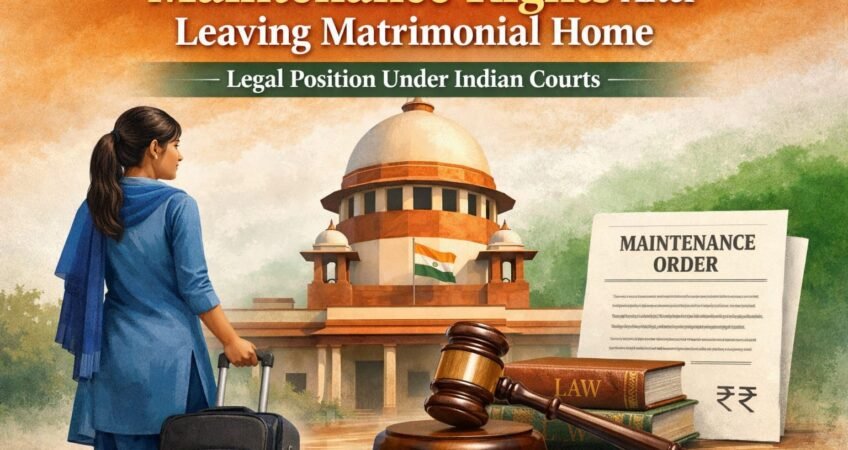
Marriage, as a legal institution, brings with it certain rights and responsibilities. However, when disputes arise and a wife chooses to leave the matrimonial home, a common question emerges: Can she still claim maintenance?

This is one of the most searched and debated issues in family law. The answer is not a simple yes or no—it depends on the facts, circumstances, and legal grounds involved.

What is Maintenance Under Indian Law?

Maintenance refers to financial support provided by one spouse to another who is unable to maintain themselves.

In India, a wife can claim maintenance under various laws, including:

  • Section 125 CrPC
  • Hindu Marriage Act, 1955
  • Protection of Women from Domestic Violence Act, 2005

The primary objective is to ensure that the dependent spouse is not left without financial support.

Does Leaving the Matrimonial Home Affect Maintenance Rights?

Leaving the matrimonial home does not automatically disqualify a wife from claiming maintenance.

Courts generally examine why the wife left the home. The reason behind separation plays a crucial role in deciding whether maintenance should be granted or denied.

When Maintenance May Be Denied

A wife may be denied maintenance in certain situations, such as:

  1. Leaving Without Reasonable Cause

If the wife leaves the matrimonial home without sufficient or valid reason, courts may deny maintenance.

  1. Mutual Agreement to Live Separately

If both spouses mutually agree to live separately and financial terms are settled, maintenance may not be granted.

  1. Adultery

If the wife is proven to be living in adultery, maintenance claims can be rejected under applicable laws.

When Maintenance Cannot Be Denied

There are several situations where even if the wife leaves the matrimonial home, she may still be entitled to maintenance:

  1. Cruelty or Harassment

If the wife leaves due to physical or mental cruelty, she has a strong legal ground to claim maintenance.

  1. Domestic Violence

In cases involving abuse or unsafe living conditions, the law protects the wife’s right to financial support.

  1. Dowry Harassment or Threats

If the wife leaves due to dowry demands or threats, maintenance cannot be denied.

  1. Neglect by Husband

If the husband fails to provide financial support or neglects his responsibilities, the wife can claim maintenance.


Key Factors Courts Consider

Courts do not rely on assumptions—they carefully evaluate multiple factors, including:

  • Reason for leaving the matrimonial home
  • Financial status and income of both spouses
  • Standard of living during the marriage
  • Whether the wife is able to maintain herself
  • Conduct of both parties

Each case is decided on its own merits.

Separation vs Desertion: Understanding the Difference

One of the most misunderstood aspects is the difference between separation and desertion.

  • Separation may be justified due to valid reasons such as cruelty or incompatibility.
  • Desertion refers to leaving the spouse without reasonable cause and with the intention to abandon.

This distinction is critical, as it directly impacts maintenance claims.

Important Legal Insight

Courts have consistently held that maintenance laws are meant to prevent financial hardship.

Even if a wife is living separately, her right to maintenance depends on whether her decision to leave was justified.

Conclusion

Maintenance rights are not automatically lost when a wife leaves the matrimonial home.

The law focuses on fairness, circumstances, and intent rather than rigid rules. If the separation is justified, the wife remains entitled to financial support. However, if she leaves without valid reasons, maintenance may be denied.

Key Takeaway:

Legal clarity and proper understanding of rights are essential before making decisions that may have long-term consequences.

FAQs

  1. Can a working wife claim maintenance after leaving the matrimonial home?

Yes, if her income is not sufficient to maintain a similar standard of living, she may still be eligible.

  1. What is considered a valid reason for leaving the matrimonial home?

Cruelty, domestic violence, dowry harassment, or unsafe living conditions are considered valid reasons.

  1. Can maintenance be denied if the wife leaves without informing the husband?

Yes, if the court finds that she left without reasonable cause, maintenance may be denied.

  1. Is maintenance automatic after separation?

No, it depends on the facts, evidence, and financial condition of both parties.

  1. Which law governs maintenance in such cases?

Maintenance can be claimed under Section 125 CrPC, the Hindu Marriage Act, and the Domestic Violence Act.

Written by Adv. Karan Dua, practising in Delhi, focuses on matrimonial and family law matters

Disputes relating to a child’s relocation or travel abroad are increasingly common in matrimonial conflicts. Such situations often arise during divorce proceedings, custody battles, or even after separation. Indian courts approach these matters with a clear and consistent principle — the welfare and best interest of the child is paramount above all else.

This article provides a detailed understanding of whether a husband can legally stop his wife from taking their child abroad, and what remedies are available under Indian law.

  1. Legal Position Under Indian Law

In India, both parents generally have rights over their child, especially in the absence of a court order granting exclusive custody. However, these rights are not absolute.

The governing principle is derived from laws such as:

  • Guardians and Wards Act, 1890
  • Hindu Minority and Guardianship Act, 1956 (for Hindus)

Under these laws, courts prioritize:
✔ Welfare of the child
✔ Emotional, educational, and social development
✔ Stability and security

  1. Can a Husband Directly Stop the Wife?

No, a husband cannot unilaterally stop his wife from taking the child abroad.

He must seek legal intervention. Without a court order, merely objecting or protesting does not have legal enforceability.

  1. Legal Remedies Available to the Husband

(a) Filing for Injunction / Stay Order

The husband can approach the Family Court and seek an injunction restraining the wife from taking the child out of India.

The court may grant:

  • Temporary restriction (interim order)
  • Conditional permission (e.g., travel with safeguards)

(b) Child Custody Petition

If custody is disputed, the husband may file for custody or guardianship. Along with this, he can request restrictions on international travel.

(c) Look-Out Circular (LOC)

In urgent situations where there is a risk of the child being taken out of India without consent, a Look-Out Circular may be initiated through proper legal channels.

This is usually considered in serious cases involving:

  • Fear of permanent relocation
  • Violation of existing custody orders

(d) Passport Objections

If the child’s passport is being issued or renewed, the husband can raise objections before the passport authority, especially where consent of both parents is required.

  1. Important Factors Considered by Courts

Courts do not automatically restrict travel. Each case is examined on its own merits. Key considerations include:

Best Interest of the Child (most important factor)
✔ Existing custody arrangements
✔ Age and emotional needs of the child
✔ Purpose of travel (education, tourism, medical reasons, etc.)
✔ Duration of stay abroad
✔ Risk of child not returning to India
✔ Financial and social stability of both parents
✔ Consent or objections of the other parent

  1. Situations Where Courts May Allow Travel

Indian courts often permit international travel if it benefits the child. Common scenarios include:

  • Higher education opportunities abroad
  • Medical treatment unavailable in India
  • Temporary visits (vacations, family functions)
  • Better living conditions or exposure

However, courts may impose safeguards such as:
✔ Undertaking to return to India
✔ Submission of travel itinerary
✔ Security deposit or surety
✔ Regular virtual contact with the other parent

  1. Situations Where Courts May Restrict Travel

Courts may refuse permission or impose restrictions if:

  • There is a risk of parental abduction
  • The parent has previously violated court orders
  • The move may disrupt the child’s education or stability
  • Travel appears to be an attempt to defeat custody rights
  1. Role of Consent in International Travel

For minors, consent of both parents is generally required for:

  • Passport issuance
  • Visa processing (in many countries)

Lack of consent can become a strong ground for legal intervention.

  1. Key Judicial Approach

Indian judiciary consistently holds that:

“Parental rights are subordinate to the welfare of the child.”

This means neither the mother nor the father has an automatic superior claim. The child’s happiness, safety, and development remain central to every decision.

  1. Practical Advice for Parents

  • Avoid taking unilateral decisions regarding international travel
  • Seek mutual consent wherever possible
  • Maintain transparency regarding travel plans
  • Approach the court early in case of disputes
  • Focus on the child’s well-being rather than personal conflicts

 Conclusion

A husband can legally stop his wife from taking their child abroad — but only through proper legal procedures and court intervention. Courts carefully balance parental rights with the child’s best interests before granting or denying permission.

Understanding your legal rights and responsibilities can help prevent conflict and ensure that decisions are made in the best interest of the child.

(FAQs) 

1. Can a wife take a child abroad without the father’s consent?

In general, taking a child abroad without the father’s consent can lead to legal complications, especially if custody is disputed. Courts may intervene if the father challenges the move. Consent of both parents is usually important for smooth travel and legal compliance.

2. Can a husband stop his wife at the airport from taking the child abroad?

No, a husband cannot physically or directly stop the wife at the airport without a court order. However, if there is a valid court order or a Look-Out Circular (LOC), authorities may prevent the child from leaving the country.

3. What is a Look-Out Circular (LOC)?

A Look-Out Circular is a legal mechanism used to alert immigration authorities to prevent a person (including a child) from leaving India in certain situations, usually issued in serious disputes or legal proceedings.

4. Does the father’s consent matter for a child’s passport?

Yes, in most cases, the consent of both parents is required for issuing a minor’s passport. If one parent objects, the matter may require legal clarification or court intervention.

5. What if there is no custody order in place?

If no custody order exists, both parents generally have equal rights. However, taking the child abroad without informing the other parent may still be challenged in court.

6. Can the court allow the child to travel abroad without the father’s consent?

Yes, courts can allow travel without the father’s consent if it is in the best interest of the child. The court may impose conditions to ensure the child returns to India.

7. What safeguards can courts impose while allowing travel?

Courts may require:
✔ Return undertakings
✔ Submission of travel details
✔ Security deposits
✔ Regular communication with the other parent

8. Can a father get custody just to stop the child from going abroad?

No, custody decisions are not made solely to restrict travel. Courts decide custody based on the child’s welfare, not parental disputes.

9. What if the mother does not return with the child?

If a parent does not return the child as per court directions, it can lead to serious legal consequences, including contempt of court and further custody litigation.

10. Which factor is most important in such cases?

The welfare and best interest of the child is always the most important factor considered by Indian courts.

Written by Adv. Karan Dua, practising in Delhi, focuses on matrimonial and family law matters.
Maintenance is a crucial legal right designed to prevent destitution and ensure financial support for dependents. In India, one of the most widely used provisions for maintenance is Section 125 of the Code of Criminal Procedure (CrPC). It provides a quick and effective remedy for wives, children, and parents who are unable to maintain themselves.

This article explains everything you need to know about maintenance under Section 125 CrPC, including eligibility, conditions, and how courts decide such cases.

What is Section 125 CrPC?

Section 125 of the Code of Criminal Procedure is a secular provision, meaning it applies to individuals of all religions. Its primary objective is to prevent vagrancy and ensure that individuals who have sufficient means support their dependents.

Under this section, a Magistrate can order a person to provide monthly maintenance to:

  • Wife (including divorced wife who has not remarried)

  • Minor children (legitimate or illegitimate)

  • Adult children (if unable to maintain themselves due to disability)

  • Parents (father or mother)

Who Can Claim Maintenance?

1. Wife

A wife who is unable to maintain herself can file a claim. This includes:

  • Legally wedded wife

  • Divorced woman (if she has not remarried)

However, a wife may not be entitled if:

  • She is living in adultery

  • She refuses to live with her husband without valid reason

  • They are living separately by mutual consent

2. Children

Children can claim maintenance if:

  • They are minors

  • They are unable to support themselves

  • In case of adult children, only if they suffer from physical or mental disability

3. Parents

Parents who are unable to maintain themselves can also seek maintenance from their children

Key Conditions for Grant of Maintenance

To claim maintenance under Section 125 CrPC, the following conditions must be fulfilled:

  • The person from whom maintenance is claimed must have sufficient means

  • The claimant must be unable to maintain themselves

There must be neglect or refusal to provide maintenance

How Courts Decide Maintenance Amount

Courts do not follow a fixed formula. Instead, they consider multiple factors such as:

  • Income and financial status of both parties

  • Standard of living during the marriage

  • Reasonable needs of the claimant

  • Liabilities and responsibilities of the respondent

  • Cost of living and inflation

The aim is to ensure a fair and reasonable amount, not to punish either party.

Can a Working Wife Claim Maintenance?

Yes, a working wife can still claim maintenance if her income is not sufficient to maintain the same standard of living as during the marriage. Courts assess whether her earnings are adequate or merely nominal.

Procedure to File a Maintenance Case

  1. File an application before a Judicial Magistrate

  2. Provide proof of relationship and financial condition

  3. Submit evidence of neglect or refusal

  4. Attend hearings and present arguments

Consequences of Non-Payment

If a person fails to comply with a maintenance order:

  • The court may issue a warrant for recovery

  • The defaulter may face imprisonment

Conclusion

Section 125 CrPC plays a vital role in providing speedy and accessible relief to dependents. It reflects the principle that no individual should be left without basic financial support.

Courts aim to strike a balance between the needs of the claimant and the capacity of the person liable to pay. Seeking proper legal guidance can help ensure a fair outcome.

FAQs on Maintenance Under Section 125 CrPC

1. Is Section 125 CrPC applicable to all religions?

Yes, it is a secular provision and applies to individuals of all religions.

2. Can a divorced wife claim maintenance?

Yes, a divorced wife can claim maintenance if she has not remarried and is unable to maintain herself.

3. Is there a fixed amount for maintenance?

No, the amount varies based on income, lifestyle, and other relevant factors.

4. Can maintenance be claimed by parents?

Yes, parents who are unable to maintain themselves can claim maintenance from their children.

5. What if the husband refuses to pay maintenance?

The court can take legal action, including issuing a warrant or ordering imprisonment.

6. Can a working woman get maintenance?

Yes, if her income is not sufficient to meet her needs, she may still be entitled to maintenance.

Written by Adv. Karan Dua, practising in Delhi, focuses on matrimonial and family law matters.
 

Marriage in India is not only a social institution but also a legal bond governed by various personal laws. One of the most sensitive and commonly cited reasons for marital breakdown is an extramarital affair. While such situations are emotionally challenging, they also raise important legal questions—especially when it comes to divorce.

Understanding how Indian courts view extramarital relationships can help individuals make informed decisions during matrimonial disputes.

What is an Extramarital Affair in Legal Terms?

An extramarital affair generally refers to a voluntary relationship between a married person and someone other than their spouse. In legal terms, this may fall under the concept of adultery in matrimonial law.

Although adultery is no longer treated as a criminal offence in India, it still remains a significant ground for divorce under various personal laws.

Adultery and Indian Law: The Legal Position

In the landmark judgment of Joseph Shine v. Union of India, the Supreme Court decriminalized adultery by striking down Section 497 of the Indian Penal Code.

This means that while a person cannot be punished criminally for adultery, it continues to have relevance in civil matters such as divorce proceedings.

Is Extramarital Affair a Ground for Divorce?

Yes, under laws such as the Hindu Marriage Act, an extramarital affair is recognized as a valid ground for divorce. However, proving adultery in court requires evidence and cannot be based solely on suspicion or allegations.

Courts typically look for:

  • Clear proof of a relationship outside marriage

  • Circumstantial evidence indicating intimacy

  • Communication records or other supporting material

What Do Courts Consider in Such Cases?

1. Evidence and Proof

Indian courts require strong and convincing evidence to establish adultery. Direct proof is rare, so courts often rely on circumstantial evidence such as hotel records, messages, or witness statements.

2. Impact on Marriage

Courts examine whether the affair has led to a breakdown of the marital relationship. The focus is often on whether the trust and foundation of the marriage have been irreparably damaged.

3. Mental Cruelty

In many cases, an extramarital affair may also amount to mental cruelty. Continuous neglect, emotional distress, or humiliation caused by such behavior can strengthen a divorce claim.

4. Conduct of Both Parties

Courts may also consider the behavior of both spouses before and after the allegations. This helps in assessing the overall circumstances of the case.

Can You File for Divorce Without Direct Proof?

While direct evidence may not always be available, courts accept circumstantial evidence if it strongly indicates the existence of an extramarital relationship. However, mere suspicion is not enough.

It is important to present a consistent set of facts that logically point toward the alleged conduct.

Legal Consequences Beyond Divorce

1. Maintenance and Alimony

An extramarital affair may influence decisions related to maintenance or alimony, depending on the facts of the case. Courts assess financial needs, conduct, and fairness before deciding.

2. Child Custody

Custody decisions are primarily based on the welfare of the child. While an affair may be considered, it is not the sole determining factor unless it directly affects the child’s well-being.

3. Settlement Agreements

In some cases, parties may choose to settle matters mutually. Extramarital issues can play a role in negotiations regarding financial and personal terms.

Important Legal Considerations

  • Adultery is not a criminal offence, but still a valid ground for divorce

  • Proof is essential—mere allegations are not sufficient

  • Courts focus on fairness, evidence, and impact on marriage

  • Each case is decided based on its individual facts and circumstances

Conclusion

Extramarital affairs remain one of the most complex aspects of divorce law in India. While the legal system no longer treats adultery as a crime, it continues to play a significant role in matrimonial disputes.

Indian courts adopt a balanced approach by focusing on evidence, the impact on the relationship, and overall fairness. For individuals facing such situations, awareness of legal rights and procedures is crucial in navigating the process effectively.

Written by Adv. Karan Dua, practising in Delhi, focuses on matrimonial and family law matters.