
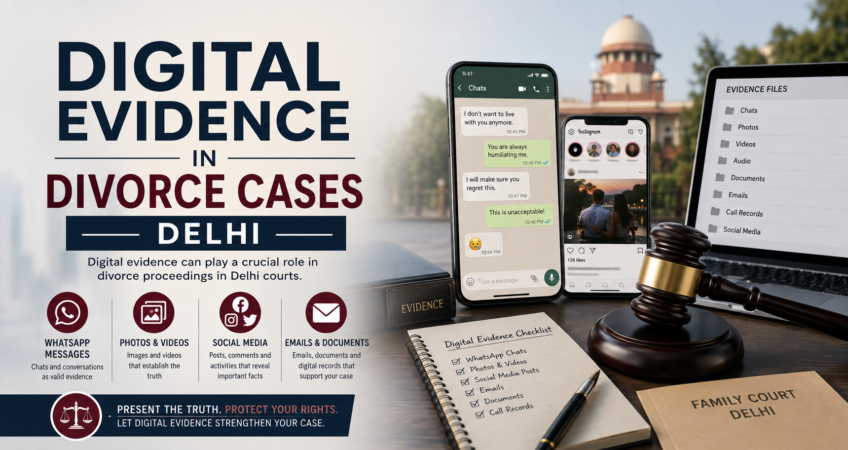
Digital Evidence in Divorce Cases: Complete 2026 Guide for Delhi Courts — WhatsApp, Social Media & AI-Generated Content Explained
Digital Evidence in Divorce Cases: Complete 2026 Guide for Delhi Courts — WhatsApp, Social Media & AI-Generated Content Explained
Introduction: When Your Phone Becomes Your Best Lawyer
Your spouse’s Instagram story. A WhatsApp message from three years ago. A screenshot of their dating app. A voice recording of an argument.
These aren’t just memories anymore—they’re legal weapons in the courtroom.
In 2026, digital evidence has fundamentally transformed how divorce cases unfold in Delhi’s family courts. Where lawyers once relied solely on bank statements and witness testimony, they now navigate a complex terrain of social media posts, encrypted messaging apps, GPS location data, and AI-generated content. The courts have adapted too. Delhi’s judges now routinely admit WhatsApp chats, Instagram screenshots, and even deleted data as critical evidence.
But here’s what most separating couples don’t understand: a screenshot without the proper certificate is worthless in court. A cleverly edited message can destroy your credibility. And collecting evidence the wrong way can backfire spectacularly—turning you into the accused, not the protected party.
This guide walks you through everything you need to know about digital evidence in Delhi divorce cases. Whether you’re filing for mutual divorce, navigating a contested divorce, fighting a custody battle, or defending against false allegations, understanding these rules is no longer optional—it’s essential.
Why Digital Evidence Matters in Delhi Divorce Cases
Delhi’s family courts process approximately 8,000–9,000 divorce cases annually. That number has been rising steadily for the past decade. With it, the reliance on digital evidence has skyrocketed.
According to recent data, over 80% of matrimonial disputes filed in Delhi now include some form of digital evidence—whether it’s WhatsApp messages, social media screenshots, call recordings, or financial transaction records.
The reason is straightforward: digital evidence is immediate, permanent, and difficult to dispute. A spouse’s Instagram post admitting to an affair, a WhatsApp message revealing hidden assets, or an email threatening violence speaks for itself. Unlike witness testimony (which can be contradicted), digital evidence creates a permanent record.
But this same power makes it dangerous.
Courts in Delhi recognize the ease with which digital evidence can be fabricated, edited, or selectively presented. A single screenshot can be photoshopped in minutes. A voice recording can be spliced. A deleted message can tell a misleading story. That’s why Delhi courts—and especially the Delhi High Court—have developed strict rules about what digital evidence can be admitted, and under what conditions.
Get these rules wrong, and your evidence gets thrown out. Get them right, and you win your case.
The Legal Framework for Digital Evidence in Delhi Courts
Section 65B of the Indian Evidence Act (and Its Modern Replacement)
For decades, digital evidence admissibility in India was governed by Section 65B of the Indian Evidence Act, 1872. This section laid out specific requirements for when electronic records could be accepted as evidence.
The problem? It was complicated, inconsistently applied, and ripe for litigation.
In July 2024, India introduced the Bharatiya Sakshya Adhiniyam (BSA), 2023, a comprehensive overhaul of evidence law. It didn’t eliminate the core principles of Section 65B—instead, it streamlined them and made them more practical for digital-age disputes.
Here’s what changed:
Under the new BSA, Section 63 now governs electronic evidence admissibility. The key requirements remain largely the same, but the process is now faster and clearer. Delhi courts, including those at Saket District Court, Rohini, and Karkardooma, have already begun implementing these new standards.
The Golden Rule: Primary vs. Secondary Evidence
The single most important distinction in digital evidence law is primary vs. secondary evidence.
Primary Evidence = The original device itself (your spouse’s mobile phone, the laptop where the email was sent, etc.). If you bring the actual phone into court and display the message on its screen, you have primary evidence. No certificate required.
Secondary Evidence = A copy (a screenshot, a printout, an exported file). This is what most people actually have. If you want to use a screenshot of a WhatsApp message, that’s secondary evidence, and it absolutely requires a certificate under Section 63/65B of the law.
This distinction has trapped countless clients. They arrive at their lawyer’s office with a folder of WhatsApp screenshots—evidence they believe is bulletproof—only to learn that without a proper certificate, the judge may dismiss it entirely.
WhatsApp Messages as Evidence: The Complete Rules
WhatsApp is the most common source of digital evidence in Delhi divorce cases. It’s intimate (couples message constantly), revealing (people say things in private chats they’d never say in court), and seemingly permanent (chats are stored indefinitely).
But admitting WhatsApp evidence has specific, non-negotiable requirements.
What Delhi Courts Accept (and Reject)
Admissible WhatsApp Evidence:
- A message clearly sent or received by your spouse (with their profile picture, contact name, and timestamp visible)
- Abusive language, confessions of infidelity, or admissions of financial fraud
- Threats of violence or harassment
- Scheduling messages about custody handovers or maintenance payments
- Group chat messages where your spouse makes damaging admissions
Inadmissible WhatsApp Evidence (Without Proper Certification):
- A screenshot sent to you by someone else (you can’t authenticate it)
- A forwarded message (courts question whether it’s been edited)
- A message with metadata removed (timestamps, contact details)
- A screenshot without visible phone details or chat context
- A message presented without the surrounding conversation (cherry-picked messages look suspicious)
The Section 65B Certificate: What It Is and Why It Matters
If you plan to use WhatsApp screenshots as evidence, you need a Section 65B certificate (now Section 63 certificate under the BSA).
This certificate must:
- Be signed by the person in charge of the computer/device where the WhatsApp account exists (you, if it’s your phone; your spouse, if obtained lawfully)
- Confirm that the device was functioning properly and in regular use during the relevant period
- State that the information was fed into the system in the ordinary course of business (or personal communication, in a divorce context)
- Include hash values and metadata confirming the integrity of the file
- Be on the letterhead of the device manufacturer or a certified forensic expert if obtained from a third party
Here’s the practical problem: Most divorcing clients don’t have this certificate. They have screenshots, but no professional certification. When they present this evidence to court without the certificate, the opposing counsel challenges its authenticity, and the judge may rule it inadmissible.
Pro Tip: If you’re in the early stages of a divorce, preserve your WhatsApp chats with metadata intact. Use apps or forensic tools designed for legal evidence preservation. When you consult a lawyer (like our team at Vintage Litigation), we can guide you on obtaining proper certification.
The Supreme Court’s Game-Changing Ruling (Arjun Panditrao Khotkar v. Kailash Kushanrao Gorantyal, 2020)
Delhi courts follow the Supreme Court’s landmark decision in Arjun Panditrao Khotkar v. Kailash Kushanrao Gorantyal (2020) 7 SCC 1.
This ruling clarified two critical points:
- If you produce the original device (e.g., your spouse’s phone, brought into court and opened live), no certificate is required. The judge can see the WhatsApp message directly on the device.
- If you produce a copy (screenshot, printout, exported file), a Section 65B/63 certificate is absolutely mandatory. No exceptions.
This ruling applies to all Delhi family courts—from Tis Hazari to Patiala House Court.
Social Media as Evidence: Instagram, Facebook, Twitter & Dating Apps
Social media has become a goldmine of evidence in divorce cases. People present carefully curated versions of their lives online—and sometimes, they slip.
An Instagram post showing luxurious vacations right after claiming financial hardship in court. A Facebook photo with a new romantic partner posted before the separation was finalized. A LinkedIn post revealing hidden employment income. A dating app profile created before the divorce was filed.
These aren’t just embarrassing—they’re legally devastating.
What Counts as Admissible Social Media Evidence
Admissible:
- Public posts (visible to anyone, with no privacy settings). These are easier for courts to accept because anyone could have seen them.
- Timestamps visible (showing the exact date and time the post was made)
- Screenshots including the full context (not just a cropped portion of a caption)
- Posts by your spouse themselves (not posts made by others about your spouse)
- Evidence of infidelity, hidden assets, or poor parenting (directly relevant to divorce, maintenance, or custody claims)
Potentially Inadmissible:
- Screenshots from private messages or stories (unless the user shared them with you directly)
- Screenshots without metadata (no timestamp, account confirmation, or visible profile picture)
- Posts from years ago (courts question relevance and may view them as prejudicial rather than probative)
- Hearsay posts (e.g., someone else posting about your spouse, rather than your spouse’s own post)
Real Case Example: The Instagram Victory
In a recent child custody dispute at Saket Family Court, a mother claimed she was a devoted, hands-on parent. But her Instagram revealed a different story: frequent international vacations, late-night parties, and almost no photos with her child. Screenshots of these posts, combined with metadata and timestamps, helped the court award primary custody to the father. The mother’s carefully constructed online persona collapsed under scrutiny.
Call Recordings and Audio Evidence in Divorce
Delhi courts increasingly accept call recordings and audio evidence—but only under strict conditions.
The Law on Recording Your Spouse
This is where many people get into serious legal trouble.
In India, recording someone without their knowledge or consent is generally illegal. Under Section 72A of the Information Technology Act, 2000, unlawfully intercepting or recording private communications is a criminal offense. Your spouse could file a case against you—and win.
However, there’s an exception: If both parties know they’re being recorded, or if you’re a party to the conversation yourself, recording is legal.
Practical translation for divorcing couples:
- Illegal: Using spyware to secretly record your spouse’s phone calls or video chats
- Illegal: Hacking into your spouse’s email or cloud storage to retrieve recordings
- Legal: Recording a phone call where both you and your spouse are participating (you’re telling them you’re recording)
- Legal: Recording a face-to-face conversation where both parties are present and aware
- Legal: Using legally obtained recordings (e.g., a recording your spouse themselves saved and shared with you)
Even when a recording is legal, it still needs authentication in court. You must prove:
- The recording is genuine (not edited or spliced)
- The voices are identifiable (it’s actually your spouse speaking)
- The conversation’s context is clear (what was being discussed, when it occurred)
Call recordings are particularly powerful evidence in domestic violence cases and 498A defense cases, where your spouse’s own words—threats, admissions, abuse—can be your strongest defense.
AI-Generated Content: The New Frontier (2026)
Welcome to the frontier of digital evidence that courts are still figuring out.
AI-generated content—deepfakes, AI text generation, synthetic videos—has exploded in 2025-2026. And divorce cases are no exception.
A spouse could create a fake WhatsApp screenshot using AI. They could generate an AI-synthesized voice recording. They could create a deepfake video. Courts have started seeing these, and judges are becoming skeptical of any digital evidence they can’t verify independently.
How to protect yourself:
- Use forensic analysis to verify the authenticity of digital evidence against you. If your spouse claims you sent an abusive message, demand a forensic examination of the device.
- Preserve original metadata. Screenshots without metadata are increasingly viewed with suspicion.
- Have digital evidence certified by a professional. A certified forensic report carries far more weight than a simple screenshot.
- Be aware of deepfake technology. If a video or audio recording of you surfaces and seems out of character, have it analyzed by an expert before panicking.
Step-by-Step Guide: How to Legally Collect Digital Evidence
If you’re in the early stages of a divorce or anticipate one, here’s how to gather digital evidence the right way:
Step 1: Preserve Evidence Immediately
Don’t wait. Save WhatsApp chats, take screenshots, download emails. Use tools specifically designed for evidence preservation that maintain metadata and hash values.
Step 2: Maintain the Chain of Custody
Document when you collected the evidence, where it came from, and how you stored it. Don’t edit, manipulate, or alter anything. Each change undermines authenticity.
Step 3: Screenshot with Full Context
Include the entire conversation thread (not just one damaging message). Include metadata: timestamps, contact names, profile pictures, phone model.
Step 4: Backup to Secure Storage
Store copies on a password-protected cloud service or external drive. Avoid storing evidence only on your phone—devices can be damaged, lost, or hacked.
Step 5: Consult a Lawyer Before Using Evidence
This is critical. A lawyer can advise whether the evidence is actually admissible, whether collecting it violated anyone’s privacy, and how best to present it in court.
Step 6: Obtain Professional Certification if Needed
If the evidence is crucial to your case, have it certified by a forensic expert. The cost ($200-500 typically) is worth it for evidence that could determine custody or asset division.
Common Mistakes That Destroy Digital Evidence Cases
Mistake 1: Using Hacked or Unlawfully Obtained Evidence
Your boyfriend obtained screenshots from your spouse’s private Facebook message. This is illegal. The court will reject it—and may punish you for attempting to introduce unlawful evidence.
Mistake 2: Presenting Cherry-Picked Messages
You extract five damaging WhatsApp messages from a 500-message conversation, ignoring context. The opposing counsel presents the full conversation, which shows the messages were responses to your provocations. Your credibility collapses.
Mistake 3: Editing Screenshots
You use photo editing software to crop out a date or remove an unwanted phrase. Courts employ forensic experts who can detect manipulation. This is evidence tampering—a serious legal violation.
Mistake 4: Mixing Digital Evidence with Hearsay
You present a screenshot of a WhatsApp message, but you can’t verify who actually sent it (your spouse’s account could’ve been hacked, a family member could’ve sent it). Courts reject it as hearsay.
Mistake 5: Forgetting to Certify Secondary Evidence
You bring 20 screenshots to court, but no Section 65B certificate. The judge dismisses them all. You spent months gathering evidence for nothing.
Mistake 6: Assuming Deleted Evidence Is Gone
You deleted a WhatsApp message thinking it’s gone forever. A forensic expert can still recover it. Now the opposing side has evidence you tried to hide—which makes judges suspicious of your entire case.
Digital Evidence in Specific Types of Divorce Cases
Contested Divorce (Adultery & Cruelty)
Digital evidence is often decisive here. WhatsApp chats with a third party, dating app profiles, Facebook posts from a lover, or explicit photos can prove adultery. Abusive messages prove mental cruelty. We’ve helped clients at Tis Hazari use digital evidence to establish grounds for divorce when witness testimony was unavailable.
Child Custody Disputes
Courts use social media to assess parenting fitness. A parent’s Instagram showing consistent engagement with the child strengthens a custody bid. Conversely, posts showing substance abuse, reckless behavior, or neglect harm custody claims. We’ve successfully used social media evidence at Saket District Court to establish fitness or unfitness for custody.
Maintenance & Alimony Claims
Hidden income is the battleground here. Digital evidence—emails revealing business ventures, social media posts showing lavish spending, bank statements accessed through digital platforms—can prove a spouse’s true financial capacity. Courts at Dwarka Court have increased maintenance awards based on digital evidence of hidden income.
498A Defense
False dowry allegations are serious. Digital evidence is your shield. WhatsApp messages between your spouse and a friend admitting the charges are false, emails discussing a false complaint, or voice recordings where your spouse recants can destroy the prosecution’s case. We’ve helped clients defend against 498A charges using digital evidence.
Domestic Violence & Protection Orders
Threatening WhatsApp messages, abusive call recordings, and harassing emails are critical evidence. Courts grant protection orders and DV Act relief based on this evidence. Quick response matters—the sooner you document abuse digitally, the stronger your case.
Frequently Asked Questions
Q: Can I use a screenshot of a WhatsApp message without a Section 65B certificate?
A: Not reliably. While some courts may accept it, the opposing counsel can challenge it, and the judge has the discretion to reject it. To be safe, always obtain a Section 65B/63 certificate for screenshots.
Q: What if my spouse’s phone contains the original WhatsApp chat? Can I access it?
A: Not without their consent or a court order. Unlawfully accessing their phone violates privacy laws. If you need evidence from their device, consult a lawyer about obtaining it through legal channels (discovery, court order, etc.).
Q: Are call recordings admissible in Delhi divorce courts?
A: Yes, if they’re legally obtained (both parties aware of recording) and properly authenticated. A forensic analysis proving the recording is genuine and unedited strengthens admissibility.
Q: How long do Delhi courts accept digital evidence? Can I use WhatsApp messages from 10 years ago?
A: Courts generally accept dated evidence if it’s relevant. However, very old evidence may be viewed as less probative (less useful in proving current issues like custody or maintenance). Recent evidence is always stronger.
Q: What if I have a screenshot but can’t remember when it was taken?
A: Metadata embedded in the file (timestamp, device information) proves when it was captured. If the metadata is missing, the screenshot’s credibility weakens. Always preserve full metadata.
Q: Can social media posts from my spouse’s private account be used as evidence?
A: Not without their consent or a court order. Private posts are protected by privacy law. However, if they voluntarily shared the post with you, you can use it.
Q: Is it legal to hire a forensic expert to recover deleted messages from my spouse’s phone?
A: Only if you have lawful access to the phone (e.g., they gave you permission, or a court ordered you to access it). Hiring someone to hack into their device is illegal.
Q: What’s the difference between a Section 65B certificate and a Section 63 certificate?
A: Section 65B was the old law (repealed July 2024). Section 63 of the BSA is the new law. Both serve the same purpose—certifying the authenticity of electronic evidence. Delhi courts now use Section 63, though references to Section 65B still appear in some cases.
Q: If I’m the one accused of sending an abusive message, how do I defend myself?
A: You can challenge the message’s authenticity (demand a forensic analysis), argue it’s been taken out of context, or prove someone else accessed your account. This is where legal expertise matters. Contact us immediately if you’re facing digital evidence against you.
Q: Can AI-generated deepfakes be detected in court?
A: Advanced forensic analysis can detect deepfakes, but it’s specialized and expensive. If you believe evidence against you is synthetic, consult a lawyer immediately—waiting weakens your defense.
How Vintage Litigation Handles Digital Evidence Cases
At Vintage Litigation, we’ve handled hundreds of divorce cases where digital evidence was central. Our approach:
- Immediate Preservation: We guide clients on legally preserving digital evidence without violating privacy laws.
- Expert Certification: We work with forensic experts to properly certify WhatsApp, social media, and call-recording evidence.
- Strategic Presentation: We know how to present digital evidence to judges at Saket, Rohini, Karkardooma, and all Delhi family courts. Timing, context, and narrative matter.
- Defense Against Fabricated Evidence: If you’re accused based on digital evidence, we challenge its authenticity and credibility aggressively.
- Higher Court Appeals: For cases at the Delhi High Court or Supreme Court, we handle complex digital evidence issues with precision.
We’ve won cases where digital evidence was initially overlooked, and we’ve dismantled cases based on fabricated digital evidence. Advocate Karan Dua’s 10+ years of experience includes mastery of how digital evidence plays out in contested divorces, custody battles, and false allegation defenses.
Conclusion: Your Phone Is Your Evidence—Use It Wisely
Digital evidence has transformed divorce law. A single WhatsApp message can prove your spouse’s infidelity. A voice recording can document abuse. A social media post can reveal hidden assets or unfitness for custody.
But power comes with responsibility. Evidence collected unlawfully is inadmissible. Evidence presented without proper certification is vulnerable. Evidence manipulated or taken out of context can destroy your credibility.
The couples who win in 2026 aren’t those with the most damaging screenshots—they’re those with properly preserved, professionally certified, legally obtained evidence presented by a skilled attorney who understands how Delhi courts evaluate digital proof.
If you’re in the early stages of a separation or anticipate a divorce, consult a lawyer now—before you gather evidence, not after. If you already have digital evidence, have a lawyer evaluate it. And if you’re facing accusations based on digital evidence, get legal help immediately.
Vintage Litigation has guided over 500 clients through divorce cases where digital evidence played a crucial role. We understand the technical requirements, the legal standards, and the strategic presentation needed to win.