
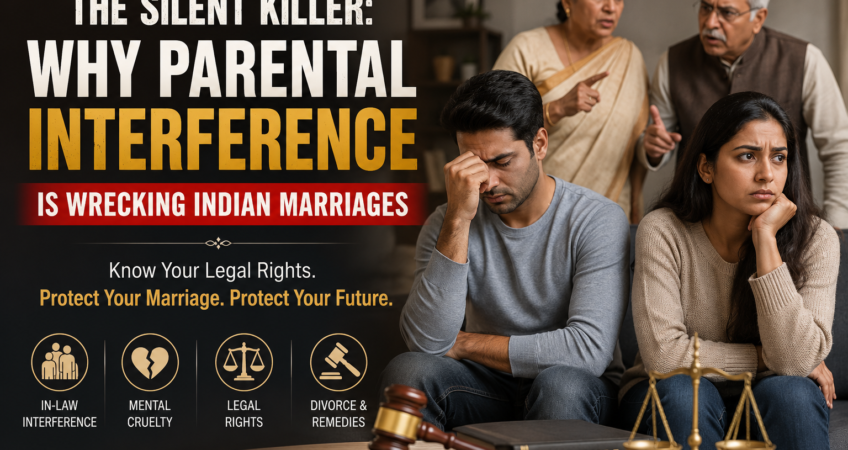
Parental Interference in Marriage: The Hidden Crisis Destroying Indian Families
The Silent Killer: Why Parental Interference is Wrecking Indian Marriages
Priya and Rajesh got married four years ago. Like most couples, they were in love, excited about their future. But within months, everything changed.
Rajesh’s mother moved in with them. Then came the criticism about how Priya managed the household, cooked food, dressed, and spent time with her own family. Every decision—where to eat, how much money to spend, which holidays to take—became a battleground between the couple and Rajesh’s parents.
Priya found herself caught in the middle. Rajesh felt torn between his loyalty to his parents and his commitment to his wife. Arguments became screaming matches. The intimacy vanished. What started as a loving marriage became a war zone.
Three years later, they filed for divorce.
Priya and Rajesh’s story is not unique. It’s becoming the norm.
According to a 2025 scoping review published in the Indian Journal of Community Medicine, parental interference has emerged as one of the most significant factors driving marital breakdown in India. The research found a strong association between excessive parental involvement and marital instability, with an effect size of 0.65—meaning parental interference is not just a minor irritant; it’s a major marriage-killer.
In India, where marriage is traditionally viewed as the union of two families rather than two individuals, this is a crisis few are talking about. But the numbers are undeniable.
By the Numbers: How Bad Is the Parental Interference Problem?
The data is staggering:
- Delhi leads the nation with 8,000–9,000 divorce cases filed every year—a tenfold increase from just 1,000 cases in the 1990s
- Divorce rates have doubled in urban India from 1.3% to 2.6% over the past decade
- Kerala, India’s most literate state, has seen a 350% increase in divorce cases in the last ten years
- Most divorces happen between ages 25–39, often among younger couples who are still financially dependent on parents
The common thread? Parental interference and family meddling feature prominently in nearly 60% of matrimonial disputes according to family lawyers and court records across Delhi’s family courts.
What Changed?
In your parents’ generation, this wasn’t an issue. Why? Because:
- Joint family structures were mandatory—parents had authority, and couples accepted it without question
- Economic dependency was total—women and even men couldn’t leave because they had no financial independence
- Social stigma was absolute—divorce meant social death, so couples suffered in silence
- Independence was rare—young couples rarely moved to separate homes
Today, everything is different. Young people are educated, earning, independent. They value autonomy and equality in relationships. But their parents still act as if it’s 1975.
This collision between traditional parental authority and modern expectations is tearing marriages apart.
The Real Cost: How Parental Interference Destroys Marriages
Let’s be clear about what happens when parents interfere. It’s not just arguments about minor decisions. The damage is deep and systematic.
1. Loss of Privacy and Boundary Erosion
When parents live with or frequently intrude into a couple’s life, there’s no private space for the marriage to breathe. Every conversation between husband and wife gets interrupted, questioned, or overheard.
In Indian households, it’s not uncommon for parents to:
- Walk into a couple’s bedroom unannounced
- Criticize intimate decisions
- Share marital problems with extended family
- Make decisions about family planning without consulting the couple
The legal issue? Under Indian law, a husband and wife have the fundamental right to privacy and autonomy in their matrimonial home. Parental interference can become grounds for mental cruelty claims under Section 13(1)(ia) of the Hindu Marriage Act, 1955.
2. Divided Loyalty and Emotional Enmeshment
The research is clear: excessive parental involvement creates what therapists call “enmeshment”—where boundaries between parent and adult child become blurred.
Typically, this plays out like this:
- Wife’s perspective: “My husband won’t take my side. He always chooses his parents over me.”
- Husband’s perspective: “My wife is disrespectful to my parents. How can I choose her over my family?”
The couple never gets to be us. They’re stuck being me and my family versus you and your family.
Research shows that husbands with overbearing mothers often feel emasculated and overshadowed, while wives struggle with divided loyalty between their own families and their husband’s family—especially if they’ve moved into a joint family home.
The legal consequence? This emotional entanglement often leads to allegations of cruelty from both sides. Wives file cases claiming the husband is under parental control and has abandoned his marital duties. Husbands countersue, claiming the wife is disrespectful to the family.
3. Financial Control and Economic Abuse
Parental interference often manifests as financial control. Parents manage the family budget, control spending, and make major financial decisions.
Common scenarios:
- “You can’t buy that without asking my parents”
- “All my salary goes to my parents; I have no money for our expenses”
- “My parents say we can’t afford a separate apartment”
- “My parents are loaning us money, so they have a say in every decision”
When one or both spouses cannot make financial decisions without parental approval, it creates resentment, loss of autonomy, and often, psychological control.
Legally, this can constitute financial abuse and mental cruelty. Under the Domestic Violence Act, 2005, economic abuse is a form of domestic violence—and it applies whether it comes from a spouse, parent, or in-laws.
4. Communication Breakdown
Healthy marriages require direct, honest communication between spouses. Parental interference prevents this.
Instead of a couple working through disagreements privately, parents intervene:
- Taking sides
- Amplifying grievances
- Preventing reconciliation
- Creating new conflicts
The couple never learns to resolve issues as partners. Every problem escalates into a family matter.
The Legal Battlefield: How Parental Interference Shows Up in Divorce Courts
When couples file for divorce, parental interference doesn’t always appear explicitly. But it lurks beneath the surface of almost every contested case.
Common Legal Claims Arising from Parental Interference
1. Cruelty (Section 13(1)(ia), Hindu Marriage Act)
This is the most frequently cited ground. Spouses allege that the other spouse allowed parents to emotionally harm them:
- “My husband allowed his mother to insult me daily”
- “My in-laws conspired to poison my husband against me”
- “My husband abandoned marital duties at his mother’s command”
What qualifies as cruelty due to parental interference?
- Consistent disrespect and humiliation by in-laws with spouse’s tacit approval
- Forcing spouse to do excessive housework under parental pressure
- Restricting movement, education, or career under parental control
- Forcing spouse to take on the entire financial burden of in-laws
2. Dowry Harassment and 498A
In many cases, parental greed drives dowry-related harassment. Parents (not just the spouse) demand money, jewelry, or property from the bride’s family—and when demands aren’t met, they harass the bride.
- This can be filed under Section 498A of the Indian Penal Code (cruelty by husband or his relatives)
- Section 406 IPC (criminal breach of trust)
- The Dowry Prohibition Act, 1961
At Vintage Litigation, we’ve seen cases where the husband is actually sympathetic to the wife, but his parents have driven the harassment. The wife still has grounds to file, and she often does.
3. Maintenance and Alimony Disputes
When parents control finances, maintenance disputes become extraordinarily complex. Courts must determine:
- What are the actual resources available?
- What portion does the spouse actually control?
- Can the spouse afford maintenance if separated from parental resources?
Section 125 (Criminal Procedure Code) and Section 24 (Hindu Marriage Act) require courts to assess the spouse’s independent earning capacity and resources—not what parents provide.
4. Child Custody Cases
If parental interference led to the marriage breakdown, it becomes highly relevant in custody disputes. Courts assess:
- Which parent can provide a stable environment?
- Which parent has unhealthy family dynamics?
- Can the parent shield the child from parental interference?
Section 13A and 13B (guardianship and custody) prioritize the child’s best interests. If one parent’s family environment is toxic due to parental interference, the court may award custody to the other parent.
Real Cases from Delhi’s Family Courts: Parental Interference in Action
Case Study 1: The Mother-in-Law Battle (Saket District Court, 2023)
Anita filed for divorce after seven years of marriage, citing cruelty. Her primary complaint: her mother-in-law’s relentless criticism and her husband’s refusal to stand up to his mother.
What was the “cruelty”?
- Daily insults about her appearance, cooking, and family background
- Forced her to serve the entire extended family while her own parents visited
- Prevented her from pursuing her Master’s degree (mother-in-law called it “unnecessary”)
- Controlled her spending and social life
The husband contested, saying his mother was “just traditional” and Anita was “too sensitive.”
Court’s verdict: Divorce granted on grounds of cruelty. The judge noted: “A spouse’s failure to protect their partner from parental harassment and mental cruelty is itself a form of cruelty. Marriage requires two people to prioritize their relationship; allowing family to undermine it is abandonment of marital duties.”
Legal principle: Cruelty is not limited to physical harm; psychological harm caused or enabled by a spouse constitutes cruelty.
Case Study 2: Financial Control and Economic Abuse (Tis Hazari Family Court, 2024)
Vikram and Priya both earned good salaries. But Vikram’s parents demanded he give his entire salary to them. He had no money for household expenses, let alone his wife’s medical care or his child’s education.
Priya filed for maintenance under Section 125 CrPC and divorce.
Vikram’s defense: “My parents are old. It’s my duty to support them. My parents are aging; I have cultural and religious obligations.”
Court’s verdict: Maintenance awarded to Priya. The judge ruled that parental support obligations cannot override spousal and child maintenance obligations. Moreover, the court found that by allowing his parents to control his finances completely, Vikram had committed financial abuse.
Legal principle: Economic control by parents can constitute domestic violence and grounds for divorce. Section 498A and the Domestic Violence Act explicitly recognize economic abuse.
Case Study 3: The Custody Battle (Rohini Court, 2025)
After divorce, both parents fought for custody of their 6-year-old daughter. The mother had moved back to her parents’ home; the father lived with his parents.
The mother’s argument: “My parents support me. I can provide stability.”
The father’s argument: “My parents help me earn more; my child will have more resources.”
Court’s verdict: The mother was awarded custody—not because her parents were better, but because her environment was more conducive to the child’s independence. The judge noted that the father’s complete emotional enmeshment with his parents—inability to make decisions without their approval, financial dependency at age 35—showed he couldn’t teach his daughter healthy boundaries.
Legal principle: A parent’s inability to set boundaries with their own parents and maintain emotional independence is a significant factor against them in custody disputes (Section 13A, Guardians and Wards Act).
Your Legal Rights: How to Protect Your Marriage from Parental Interference
If you’re struggling with parental interference, you have more legal options than you might think.
1. Establish Clear Boundaries (Preventive Step)
Before marital breakdown occurs, establish boundaries:
- Live separately if possible (even if in the same city)
- Communicate that certain decisions are yours alone (finances, family planning, career)
- Create a private space (bedroom, study) that’s off-limits to parents
- Set visiting schedules with clear in/out times
- Discuss parental boundaries before marriage
While not directly legal, boundary-setting can prevent the escalation that leads to legal battles.
2. Document Harassment and Threats
If parents are harassing you, document everything:
- Save messages, emails, and texts
- Note dates, times, and specific incidents of harassment
- Record audio of threats (where legal; check local laws)
- Get witness statements from neighbors, friends
- Take photos of any physical damage or harm
Why? This evidence is crucial for:
- Filing a domestic violence case under the Protection of Women from Domestic Violence Act, 2005
- Section 498A complaints (cruelty by husband and relatives)
- Divorce petitions citing cruelty
- Maintenance and custody disputes
3. File a Domestic Violence Petition
The Domestic Violence Act protects not just from spouses, but from in-laws and family members. You can seek:
- Protection orders (preventing harassment)
- Residence orders (right to stay in the matrimonial home)
- Monetary relief (for medical expenses, lost income due to harassment)
- Custody orders (interim custody of children)
This can be filed immediately—you don’t need to wait for divorce proceedings.
Section 18-21 of the Domestic Violence Act provides emergency relief and interim orders.
4. File for Divorce on Grounds of Cruelty
Parental interference that causes mental suffering is cruelty under Section 13(1)(ia) of the Hindu Marriage Act, 1955.
Elements you must prove:
- Your spouse (or with spouse’s knowledge, parents) acted in a way that caused mental suffering
- The conduct was deliberate or reckless
- It was of such nature that it made it impossible for you to live with the spouse
Evidence needed:
- Documentation of incidents
- Witness testimony
- Medical reports (if mental suffering led to health issues)
- Communications showing spouse’s role in parental interference
Note: You need to file for divorce within three years of the act of cruelty (though courts sometimes grant extension).
5. Claim Maintenance Under Section 125 CrPC or Section 24 HMA
If parental interference has financially handicapped you, you can claim maintenance:
- Section 125 CrPC: Applies regardless of religion; provides maintenance for dependents
- Section 24 HMA: Provides maintenance and litigation costs during divorce proceedings
Courts can order maintenance even if your spouse claims parents control their finances. The law holds the spouse responsible for spousal support.
6. Assert Your Right to Privacy and Autonomy
In contested divorces, courts increasingly recognize that a spouse has the right to:
- Make independent financial decisions
- Live separately from in-laws if desired
- Make healthcare and fertility decisions
- Pursue education and career
- Maintain boundaries with extended family
If your spouse prevented you from these rights, it strengthens your divorce claim.
The Bigger Picture: Why Modern Indian Courts Are Changing
India’s courts are evolving. Judges increasingly recognize that:
- Marriage is a two-person relationship, not a family merger
- Dependency on parents into adulthood is not normal or healthy, regardless of tradition
- Parental interference is a form of emotional abuse and can be grounds for divorce
- A spouse’s inability to prioritize their marriage over parental pressure is marital breakdown
In landmark cases, Indian courts have held:
- A spouse cannot hide behind “parental duty” to avoid spousal obligations
- Parents’ “cultural” or “religious” authority doesn’t override individual rights
- Economic control by parents can constitute domestic violence
- A spouse’s emotional enmeshment with parents is a factor against them in custody cases
What Should You Do Right Now?
If parental interference is damaging your marriage, here’s your action plan:
Immediate Steps (This Week)
- Document everything: Start recording incidents, times, and witnesses
- Get legal advice: Consult a family lawyer to understand your specific rights
- Reach out to support: Tell someone you trust about what’s happening
Short Term (Next 1-3 Months)
- Consider counseling: A family therapist can sometimes mediate between you, your spouse, and parents
- Set boundaries in writing: Send a message to parents clearly stating boundaries
- Plan legally: Work with a lawyer to understand divorce, maintenance, and custody options
- Secure finances: If possible, open a separate bank account and start building financial independence
Medium Term (3-6 Months)
- File for protection if needed: A domestic violence petition can provide immediate relief
- Attempt reconciliation: With or without mediation (but only if it’s safe)
- Prepare for divorce if necessary: Gather documents, evidence, and witness contacts
- Understand custody: If children are involved, understand your legal rights
Long Term
- Pursue divorce if marriage is unrecoverable
- Secure custody or visitation
- Claim maintenance if eligible
- Plan for financial independence
Key Takeaway: You’re Not Alone—And You Have Legal Recourse
Parental interference is destroying Indian marriages at scale. But here’s the hopeful part: You have legal rights.
- Your marriage is your relationship, not your parents’ or in-laws’
- Emotional abuse by in-laws (with spouse’s knowledge) is grounds for divorce
- Financial control is a form of domestic violence
- Courts now recognize these dynamics and are ruling in favor of boundaries
You don’t have to live in a marriage where your spouse prioritizes their parents over you. And you don’t have to tolerate harassment from in-laws.
FAQ: Parental Interference in Marriage and Divorce Law
Q1: Is parental interference a legal ground for divorce in India?
A: Not directly named as a ground, but it falls under cruelty (Section 13(1)(ia), Hindu Marriage Act). If parental interference causes mental suffering and your spouse participates or enables it, it’s grounds for divorce.
You must prove:
- The interference caused deliberate mental suffering
- Your spouse allowed or participated in it
- It made living together intolerable
Case law: Courts have repeatedly granted divorces citing cruelty from in-laws with spouse’s knowledge.
Q2: Can I file a case against my in-laws directly for harassment?
A: Yes, under the Protection of Women from Domestic Violence Act, 2005.
Who can you include in the complaint?
- Husband
- Mother-in-law
- Father-in-law
- Brother-in-law, sister-in-law
- Any family member causing domestic violence
Relief available:
- Protection orders (prevent harassment)
- Residence orders (right to stay in matrimonial home)
- Monetary relief
- Custody orders (interim)
You don’t need to file for divorce first; this can be a standalone petition.
Q3: My spouse earns good money but gives it to their parents. Can I get maintenance?
A: Yes. Section 125 CrPC and Section 24 HMA assess a spouse’s independent earning capacity and resources—not what their parents provide.
The court will likely:
- Calculate your spouse’s independent income
- Order them to secure money from parental control (if possible)
- If not possible, hold the spouse in contempt for non-payment
- Award you maintenance anyway (you can’t be deprived because spouse is financially enmeshed)
Key principle: A spouse cannot use parental control as an excuse to avoid spousal maintenance obligations.
Q4: My parents are aging and need support. Can I be forced to abandon them?
A: No. Indian law recognizes filial duty under:
- Section 125 CrPC (adult children can be ordered to maintain aging parents)
- The Maintenance and Welfare of Parents and Senior Citizens Act, 2007
However: Your duty to parents does NOT override your duty to spouse and children. Courts balance all obligations and order maintenance proportionally.
Example: If you earn ₹1,00,000/month and have aging parents, spouse, and child, the court divides this proportionally—not giving entire income to parents.
Q5: Can parental interference be used against me in a custody case?
A: Yes, both ways:
Against you: If you’re emotionally enmeshed with parents and cannot make independent decisions about your child’s upbringing, the court may award custody to the other parent.
In your favor: If the other parent’s family environment is toxic due to parental interference, you can argue for custody based on a more stable home.
Court’s focus: Which parent can provide a healthy, independent family environment for the child?
Q6: What if my spouse says they’re helping their parents out of love, not control?
A: Motive doesn’t matter; impact does.
From a legal standpoint:
- If parental support prevents spousal/child support, it’s problematic
- If parental interference affects the marriage, it’s relevant to divorce
- If parental presence causes mental cruelty, it’s grounds for divorce
Emotion (“love for parents”) is not a legal defense for abandoning marital duties or allowing harassment.
Q7: How much time do I have to file for divorce based on cruelty from parental interference?
A: You have three years from the date of the act of cruelty. However:
- If cruelty is ongoing/repeated, the clock resets with each incident
- Courts sometimes grant extensions if you can show reasons for delay
- It’s best to file sooner rather than later; evidence gets stale
Recommendation: File within one year of the cruelty becoming unbearable.
Q8: Can parents be called as witnesses in my divorce case?
A: Yes, if relevant. However:
- Your parents can testify about their observations of your marriage
- In-laws can testify but may have bias
- Their testimony is weighed carefully by judges
Better evidence:
- Documentary evidence (messages, communications)
- Neutral witnesses (neighbors, friends, colleagues)
- Medical records (if mental cruelty affected your health)
Q9: What’s the difference between cultural parental authority and abuse?
A: This is where modern Indian law is evolving:
Cultural authority (respected):
- Seeking blessings from parents
- Consulting parents on major decisions
- Supporting aging parents financially
- Respecting parents’ wishes where reasonable
Abuse (not tolerated):
- Controlling spouse’s movement, finances, or education
- Allowing parents to humiliate or insult spouse
- Prioritizing parental demands over marriage
- Using parental authority to prevent divorce or separation
Key test: Does it respect the spouse’s autonomy and dignity, or does it remove it?
Q10: Can we mediate with parents to save the marriage?
A: In some cases, yes. Family mediation that includes all parties can work if:
- Your spouse is willing to set boundaries
- Parents are willing to respect the marriage
- The abuse hasn’t progressed to the point of irreversible damage
- Both spouses still love each other
However: If abuse is severe or ongoing, mediation may not be safe. Always prioritize your safety first.
Professional help: Work with a certified family counselor or mediator, not just informal family discussions.
Final Words: Your Marriage, Your Choice
This is what we know from two decades of family law practice in Delhi:
Parental interference doesn’t get better on its own. It escalates. It erodes trust, intimacy, and respect. It turns couples into adversaries. And it destroys families.
But you don’t have to accept it. You have rights. You have legal remedies. And you have advocates who understand these dynamics intimately.
If you’re struggling with parental interference:
- Know that you’re not alone (it’s affecting thousands of Delhi couples right now)
- Understand that the law recognizes this harm
- Take action before it destroys your marriage or your health
Ready to Protect Your Marriage? Get Expert Legal Guidance
If parental interference is damaging your relationship, you need legal clarity on your options. Whether you’re trying to save your marriage or protect yourself in a divorce, we can help.
Schedule a confidential consultation with Advocate Karan Dua today:
Your first consultation is online and completely confidential. No hidden charges. No judgment.
We’ve helped hundreds of couples navigate family dynamics, protect their marriages, or pursue dignified divorces. Let us help you too.