
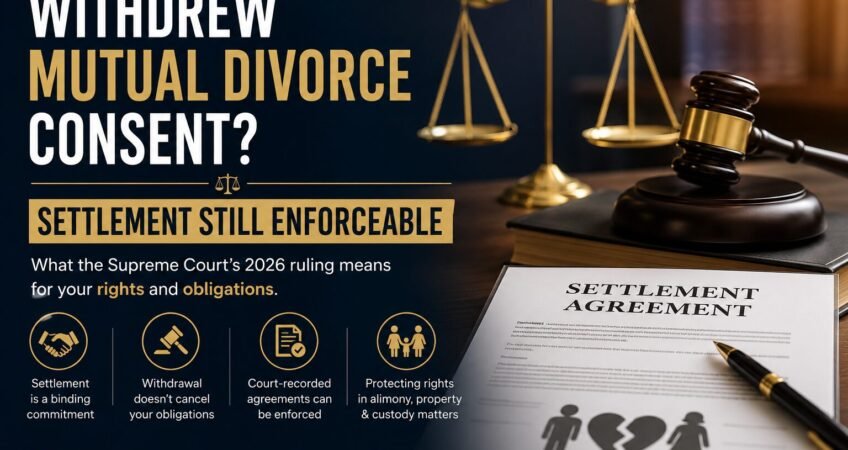
You Withdrew Mutual Divorce Consent — Can Your Spouse Still Enforce the Settlement?
By Advocate Karan Dua | Vintage Litigation, New Delhi | Published: July 2026
Here’s a scenario I see more often than you’d expect: a couple spends months negotiating a mutual divorce — alimony figures, who keeps the flat, custody schedule, all of it. They sign a detailed settlement agreement. They file the First Motion together. And then, somewhere in the six-month cooling-off period, one spouse changes their mind and tells the court they no longer consent to the divorce.
The question that follows, almost every time, is some version of: “If I withdraw, does everything we agreed on just disappear? Can they still hold me to the settlement?”
For years, the honest answer was murky. As of 2026, it isn’t anymore — and the answer surprises a lot of people. You can still walk away from the divorce itself. You generally cannot walk away from the settlement you signed.
The two things people confuse: consent to divorce vs. consent to the settlement
Indian law has always treated mutual consent divorce as requiring continuing consent — not just consent on the day you filed. The Supreme Court settled this back in Sureshta Devi v. Om Prakash (1991): either spouse can withdraw consent at any point before the final decree is passed, and if they do, the court cannot grant the divorce. That’s the entire reason the six-month cooling-off period under Section 13B(2) of the Hindu Marriage Act exists in the first place — to give both people room for genuine second thoughts.
What’s changed is the Supreme Court’s treatment of the settlement agreement itself, in Dhananjay Rathi v. Ruchika Rathi (2026). The Court drew a clear line between two separate things that used to get treated as a package deal:
- Your consent to the divorce decree — this remains freely revocable, at any time, right up until the decree is passed. No one can force you to go through with a divorce you no longer want.
- Your obligations under a signed settlement agreement — this is a separate contractual and court-recorded commitment, and the Court held it can only be undone on narrow, specific grounds: force, fraud, undue influence, or the other spouse’s own failure to perform their side of the agreement.
Changing your mind, on its own, is not one of those grounds. If none of those four conditions apply, a well-drafted settlement can still be enforced against you — even though the divorce itself doesn’t go through, or gets converted into a contested proceeding.
Why this distinction exists
It comes down to what a settlement agreement actually is in the eyes of the law. Once it’s placed on record before the family court — particularly once it’s referenced in a court order or recorded as part of the First Motion — it stops being a private understanding between two people and starts functioning as an undertaking to the court. That’s a meaningfully higher bar than an informal promise, and it’s why the Court in Dhananjay Rathi refused to let a change of heart alone unwind it.
Practically, this protects the spouse who negotiated in good faith, made commitments in reliance on the settlement (transferring an asset, agreeing to a custody schedule, dropping a separate case), and would otherwise be left exposed if the other party could simply reset the clock by withdrawing consent at the last minute.
What “enforcement” actually looks like
If your spouse withdraws consent to the divorce but you have a signed, court-recorded settlement, you’re not without options. Depending on how the settlement was structured, enforcement can take a few different forms:
1. Contempt of court proceedings. Once settlement terms are recorded as part of a court order or undertaking, violating them can expose the non-complying spouse to contempt proceedings under the Contempt of Courts Act — a materially more serious consequence than simply breaching a private contract.
2. Reviving whatever you gave up as part of the deal. This is the part people miss most often. Settlements frequently involve one spouse withdrawing a separate, pending case — a maintenance petition, a domestic violence complaint, a 498A matter — in exchange for agreed terms. If your spouse defaults on the settlement after you’ve already withdrawn that case, you generally have the right to revive it. The withdrawal was conditional on performance, not a one-way concession.
3. Direct enforcement of specific clauses. Property transfers, one-time lump-sum payments, and similar terms recorded in the settlement can often be enforced directly, since courts treat a signed, filed settlement as carrying real evidentiary and legal weight — not as a draft that either party can casually disown.
Where this gets complicated: divorce doesn’t happen, but the money still might have to move
This is the counterintuitive part, and it’s worth sitting with. If one spouse withdraws consent, the marriage doesn’t end — the court cannot grant a mutual consent decree without both parties’ ongoing agreement. But if the settlement was drafted broadly enough (i.e., its financial and property terms weren’t made strictly conditional on the decree being granted), the other spouse may still be able to pursue enforcement of specific settlement terms independently, or use the settlement as evidence in a subsequent contested proceeding.
In other words: withdrawing consent doesn’t automatically undo what you’ve already agreed to on paper. This is precisely why the drafting of a settlement agreement matters so much — vague, informal, or poorly sequenced settlements create real ambiguity here, while a carefully drafted one makes the consequences of withdrawal predictable for both sides.
The four narrow exits — what actually counts
If you’re the one looking to get out of a signed settlement (not just the divorce), know that courts scrutinize these claims closely. The four accepted grounds are:
- Force — you were physically coerced or threatened into signing.
- Fraud — you were misled about a material fact (undisclosed assets or income is a common real-world version of this).
- Undue influence — your consent wasn’t genuinely free, due to a position of dominance the other party held over you.
- The other spouse’s own default — they failed to perform an obligation they owed you under the agreement first.
A settlement being simply unfavorable in hindsight, or a change in emotional readiness for the divorce, does not meet this bar on its own. Courts are also alert to timing: a settlement that was rushed, unusually one-sided, or immediately followed by a withdrawal attempt tends to draw closer judicial scrutiny — which can cut in either direction depending on the facts.
What this means practically, for both sides
If you’re the one considering withdrawing consent: you’re free to do so regarding the divorce itself, without needing to justify the decision. But don’t assume that also unwinds every commitment in a settlement you’ve already signed. If there are financial or custody terms you’re not comfortable being held to, that needs to be addressed before signing — not after, by hoping a later withdrawal will undo it.
If you’re relying on a settlement your spouse might walk back from: the strength of your position depends heavily on how the agreement was drafted and filed. Terms should be specific, not aspirational; obligations and their triggers should be clearly sequenced (what happens first, what’s conditional on what); and if you’re giving up a separate legal remedy as part of the deal, that should be documented as conditional on the other side’s performance — not an unconditional withdrawal.
Frequently Asked Questions
Q: If my spouse withdraws consent, do I get my alimony/maintenance case back?
A: Generally, yes — if you withdrew that case as part of the settlement and your spouse later defaults on the agreed terms, courts have recognized your right to revive the proceedings you gave up.
Q: Can I be forced to go through with a mutual divorce I no longer consent to?
A: No. Consent to the divorce decree itself remains freely revocable at any point before the decree is passed — this hasn’t changed. What has changed is that your other settlement obligations don’t automatically disappear along with that withdrawal.
Q: What counts as “fraud” that would let me exit a settlement?
A: Typically, being misled about a material fact relevant to the settlement — for example, undisclosed income, assets, or liabilities that would have changed what you agreed to had you known about them at the time.
Q: Is an unsigned or informal settlement enforceable the same way?
A: No — enforceability depends heavily on the settlement being properly drafted, signed, and ideally recorded before the court. Informal understandings carry far less weight and are much easier to contest.
Q: Can settlement terms be enforced even if the divorce case eventually becomes contested?
A: Often, yes, particularly where the settlement’s terms weren’t made strictly conditional on the mutual divorce decree being granted. This is exactly why how a settlement is drafted matters as much as what it says.
Conclusion
Consent to divorce and consent to a settlement are legally distinct, and 2026’s Dhananjay Rathi v. Ruchika Rathi ruling made that distinction explicit: you can change your mind about ending the marriage without permission from anyone, but a signed settlement isn’t something you can simply opt out of on the same basis. Whether that protects you or exposes you depends entirely on how carefully the settlement was drafted in the first place — which is exactly why it’s worth having it reviewed by someone who can see how these terms actually play out in a Delhi family court, before you sign, not after.
Navigating a mutual divorce settlement, or dealing with a spouse who’s withdrawn consent after signing one? Get specific guidance for your situation.
📞 Call: +91-9999483959 | 💬 WhatsApp Us
Written by Adv. Karan Dua, practising in Delhi, focuses on matrimonial and family law matters, including mutual divorce settlements and maintenance disputes.