
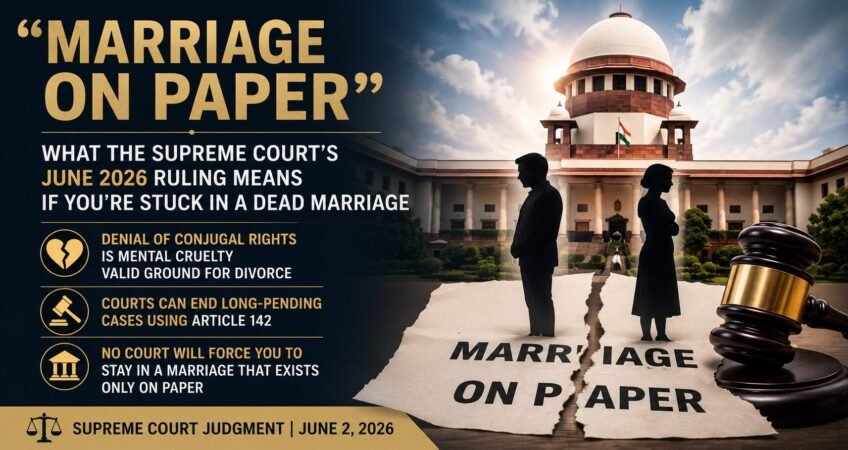
Marriage on Paper”: What the Supreme Court’s June 2026 Ruling Means If You’re Stuck in a Dead Marriage
By Advocate Karan Dua | Vintage Litigation, New Delhi | Published: July 2026
If you’ve been separated from your spouse for years — filing appeal after appeal, attending hearing after hearing, watching your case get adjourned again and again — you already know what a “marriage on paper” feels like. It isn’t a marriage. It’s a legal status that refuses to end.
On June 2, 2026, the Supreme Court put that exact phrase into a judgment. A bench of Justices Sanjay Karol and Augustine George Masih dissolved a marriage between a Gujarat-based wife and a Rajasthan-based husband — both doctors in government service — who had been living apart for more than fifteen years. The Rajasthan High Court had already granted the husband a divorce, largely on the ground that his wife had persistently denied him conjugal relations. The wife appealed to the Supreme Court. She lost.
What makes this ruling important isn’t just the outcome. It’s the reasoning. The Court used the case to lay down, in unusually direct language, two principles that every husband trapped in a long-pending matrimonial case in Delhi needs to understand: first, that denial of conjugal rights without reasonable cause is mental cruelty and a valid, independent ground for divorce under Section 13(1)(ia) of the Hindu Marriage Act, 1955; and second, that when litigation drags on for years with no realistic chance of reconciliation, the courts will step in — even using extraordinary constitutional powers — to end it, rather than force two people to remain legally bound to a relationship that exists only on paper.
This article breaks down the judgment, explains the law behind it, and sets out what it practically means if you are considering — or already fighting — a divorce case in Delhi.
The couple married in December 2007. Both were doctors employed with the government, one posted in Gujarat, the other in Rajasthan. There was no child from the marriage. According to the Court’s own reading of the record, the parties failed to establish a functioning conjugal relationship even during the limited period they lived together, and the wife had persistently refused sexual relations without any medical or otherwise reasonable justification.
The husband filed for divorce on grounds of cruelty. The family court and later the Rajasthan High Court found in his favour. The wife’s central argument on appeal was that the marriage should be preserved and that any breakdown could still be repaired. The Supreme Court disagreed. It noted that the couple had been separated for over fifteen years, that repeated attempts at reconciliation by various courts had failed, and that the wife’s own conduct — continuing to work and live independently in Gujarat with no real effort to rejoin her husband — showed the relationship had no practical future.
The Court upheld the divorce and closed the matter permanently, invoking Article 142 of the Constitution to ensure the marriage was dissolved completely rather than sent back into further rounds of litigation.
Ground One: Denial of Conjugal Rights Is Mental Cruelty
This is the part of the judgment with the widest everyday relevance, because it applies far beyond the specific facts of this one case.
Indian courts have consistently held that marriage carries reciprocal expectations — not just of financial support and companionship, but of physical intimacy as part of a functioning relationship. When one spouse persistently withholds this, without a medical condition, safety concern, or other reasonable cause, courts have treated it as a form of mental cruelty under matrimonial law.
The Supreme Court reinforced this position clearly in the June 2026 ruling, holding that consistently refusing intimacy without justification causes real emotional harm and damages the foundation the marriage is built on. This is not a new legal principle — it draws on decades of precedent — but the Court’s restatement of it in 2026, in strong and unambiguous terms, matters for two reasons:
- It removes ambiguity for family courts and High Courts hearing similar pleas. Where earlier rulings on this point were scattered and fact-specific, this judgment gives a clear, citable Supreme Court authority from 2026 that lawyers can rely on directly.
- It reframes conjugal rights as a two-way obligation, not a one-way demand. The Court was careful to note that a spouse cannot simultaneously refuse to fulfil their conjugal responsibilities and expect the other party’s obligations under the marriage to remain fully intact. Marriage, the bench observed, is a partnership of mutual respect and shared responsibility — not a one-sided arrangement.
What this means practically: if you are a husband whose wife has persistently and without reasonable cause denied conjugal relations for an extended period, this is not just a private grievance — it is a recognised, independent ground for divorce on cruelty under Section 13(1)(ia) of the Hindu Marriage Act, and the Supreme Court has, as recently as June 2026, restated the principle in your favour.
Ground Two: Courts Will Not Let a “Dead” Marriage Stay Alive on Paper Forever
The second principle is about how long courts will tolerate a matrimonial dispute dragging on before stepping in decisively.
The bench was explicit that prolonged pendency of matrimonial litigation does nothing except keep a marriage alive as a legal formality, while the real relationship has already ended. It described the emotional cost of this delay in strong terms — the frustration, the psychological toll, and the practical unfairness of denying both parties the chance to move on with their lives while a dead relationship is kept on judicial life support.
At the same time, the Court was careful to balance this against India’s long-standing judicial caution about not dissolving marriages too easily. It reiterated that courts should generally be reluctant to grant divorce simply because one party wants out — the sanctity of marriage still matters, and reconciliation should always be attempted first. But once genuine attempts at reconciliation have failed and the separation has continued for a substantial period — in this case, over fifteen years — the calculus changes. At that point, continuing the litigation serves no one.
This is consistent with a broader pattern the Supreme Court has been building through 2025 and 2026:
- In an earlier 2026 ruling widely discussed as the “Matrimonial Mahabharata” case, the Court dissolved a marriage and closed more than 80 connected civil and criminal proceedings between the parties, using its Article 142 powers to end what it called a decade-long battle that had gone far beyond any legitimate dispute.
- In another 2026 matter, the Court dissolved a marriage that had lasted just 65 days of actual cohabitation but had generated 13 years of litigation across more than 40 separate cases, imposing costs on both parties for treating the courts as a battleground rather than a forum for resolution.
Taken together with the June 2 judgment, these rulings show a consistent judicial mood: the Supreme Court is increasingly willing to use Article 142 — its special constitutional power to do “complete justice” — to bring prolonged, irretrievably broken marriages to a decisive end, rather than leave them technically pending indefinitely.
Why Article 142 Matters — and Why This Power Sits Only With the Supreme Court
Article 142 of the Constitution gives the Supreme Court a power that no other court in India has: the authority to pass any order necessary to do “complete justice” in a matter before it, even where existing statutes don’t provide a direct remedy.
In matrimonial cases, this has become significant because Indian divorce law does not, as a general statutory rule, recognise “irretrievable breakdown of marriage” as an independent ground for divorce. A family court or High Court cannot simply grant a divorce because a marriage has broken down beyond repair if none of the specific statutory grounds — cruelty, desertion, adultery, and so on — are made out. The Supreme Court, using Article 142, can go further. It can dissolve a marriage purely on the basis that it has broken down irretrievably, even without deciding fault on either side, when the facts clearly show there is no realistic prospect of the couple ever reconciling.
This is precisely the reasoning the bench applied in the June 2026 case, and it is the same reasoning behind the 65-day-marriage ruling and the Mahabharata case. In each instance, the Court treated the prolonged separation and complete breakdown of the relationship as sufficient, on its own constitutional powers, to end the marriage — separately from, and in addition to, any specific ground like cruelty that may also apply.
Important practical point: this specific pathway to divorce is only available through the Supreme Court, not through family courts or High Courts, because Article 142 applies exclusively to the apex court. For most people, the realistic and faster route through Delhi’s courts remains proving a recognised ground — such as cruelty, which, as this judgment confirms, can include persistent denial of conjugal relations.
What This Means If You’re a Husband Fighting a Divorce Case in Delhi
If you’re currently separated from your wife, facing a stalled or slow-moving matrimonial case, or considering filing for divorce, here is how this judgment is likely to affect your situation.
1. If your wife has denied you conjugal relations without reasonable cause, document it as a ground of cruelty
You don’t need to prove a single dramatic incident. Courts look at a pattern of conduct over time. Keep a factual record — dates of separation, any communication where the issue was raised, and any medical or counselling records if the matter was ever discussed with a doctor or a marriage counsellor. This ground can be pleaded independently or alongside other cruelty allegations (verbal abuse, false complaints, financial harassment, and so on).
2. Long separation strengthens, rather than weakens, your case
Some husbands worry that a long-pending case makes their position weaker. This judgment says the opposite. The longer a marriage has genuinely broken down with no reconciliation, the stronger the argument that continuing it serves no purpose — and the more likely a court is to grant relief rather than send the parties back for further attempts at settlement.
3. Evidence of your spouse’s independent life matters
In the June 2026 case, one of the factors that worked against the wife was that she continued working and living independently in another state, with no real effort to rejoin her husband. If your spouse has built an independent life — a separate residence, unchanged employment, no attempt at reconciliation over years — this is relevant evidence that the marriage has broken down irretrievably, not just that there is a temporary rift.
4. Don’t assume you need to reach the Supreme Court
Article 142 relief is powerful, but it is a last-resort constitutional remedy, typically used after years of litigation across multiple courts. Most husbands in Delhi will resolve their case far faster — often within a family court or through the Delhi High Court — by properly pleading and proving a recognised ground like cruelty (including denial of conjugal rights), rather than waiting for a case to eventually reach the Supreme Court on appeal.
5. Watch out for cross-litigation traps
Both the 65-day-marriage case and the Mahabharata case involved dozens of parallel proceedings — cheque bounce cases, 498A complaints, protection orders, contempt petitions — used strategically to prolong the fight. If you’re facing (or considering filing) multiple cases, think carefully about whether each one genuinely protects your interests or simply extends the litigation. Courts are now openly critical of parties who treat matrimonial disputes as a permanent battlefield, and this can affect how a judge views your conduct overall, including on cost orders.
6. Mediation is being pushed harder by courts
Across all three 2026 rulings discussed here, the Supreme Court repeatedly emphasised mediation and early resolution as preferable to years of adversarial litigation. If your spouse is open to a negotiated settlement — even a firm but fair one — pursuing mediation early can save years of cost, stress, and uncertainty compared to contested litigation stretching across multiple courts.
Building a Strong Cruelty Case: What Evidence Actually Helps
Denial of conjugal rights is rarely argued in isolation. Delhi family courts expect a fuller picture of the marriage’s breakdown. Useful supporting evidence typically includes:
- Timeline of separation — when the parties last cohabited, and any attempts (by you or by the court) to reconcile since.
- Communication records — messages, emails, or letters where the issue of estrangement or refusal was discussed, raised, or acknowledged.
- Witness testimony — family members, close friends, or counsellors who can speak to the state of the relationship.
- Absence of medical justification — if your spouse has claimed a health-related reason for refusal, records (or the lack of any) become relevant.
- Conduct showing independent life — continued separate residence, unchanged employment, absence of reconciliation attempts on their part.
- Record of failed reconciliation efforts — court-ordered mediation sessions, counselling attempts, or settlement talks that did not succeed.
None of this needs to be dramatic or adversarial in tone. Delhi courts respond better to a calm, well-documented, factual record than to an emotionally charged one.
What This Judgment Does Not Change
It’s worth being precise about the limits of this ruling, because overstating it can lead to bad legal strategy:
- It does not create a new, standalone right to divorce simply because a marriage is unhappy. The underlying ground still needs to be established — in this case, cruelty through persistent denial of conjugal rights, evaluated alongside the overall breakdown of the relationship.
- It does not mean every long-pending case will get fast-tracked relief. The Supreme Court was clear that its approach is fact-specific and that courts remain cautious about dissolving marriages too readily. This was a fifteen-year separation with no children and no realistic prospect of reconciliation — not every contested case looks like this.
- It does not bypass family courts and High Courts. Article 142 is available only at the Supreme Court level, typically after a case has already gone through the ordinary appellate process.
Frequently Asked Questions
Can I file for divorce solely on the ground that my wife has refused conjugal relations?
Yes. Persistent denial of conjugal relations without reasonable cause is recognised as mental cruelty under Section 13(1)(ia) of the Hindu Marriage Act, and the Supreme Court’s June 2026 ruling directly reaffirms this. It is strongest when supported by a documented pattern over time, rather than a single incident.
Does this mean the Supreme Court has made “irretrievable breakdown of marriage” a formal ground for divorce in India?
Not through ordinary legislation. Parliament has not added irretrievable breakdown as a statutory ground under the Hindu Marriage Act. However, the Supreme Court can grant divorce on this basis using its special constitutional powers under Article 142, as it has done in this case and in the “Matrimonial Mahabharata” and 65-day-marriage rulings. This power is available only to the Supreme Court, not to family courts or High Courts.
How long does my marriage need to have broken down before a court will consider it “irretrievable”?
There’s no fixed number of years in law. In the June 2026 case, the separation had lasted over fifteen years. In the 65-day-marriage case, the couple had been separated for thirteen years despite barely living together. Courts look at the totality of the circumstances — length of separation, presence of children, genuine reconciliation attempts, and the overall conduct of both parties — rather than applying a strict timeline.
My wife has filed multiple cases against me alongside the divorce petition. Does that help or hurt my case?
It depends on the nature and merit of those cases. Courts have become openly critical of parties who use multiple parallel proceedings to prolong disputes rather than resolve them. If cases appear designed mainly to pressure or exhaust the other side, this can work against the party filing them — as seen in the Mahabharata case, where the Court closed over 80 such proceedings and criticised the pattern directly.
Can my wife still claim maintenance or alimony even if the divorce is granted on cruelty grounds due to denial of conjugal rights?
Yes. A divorce being granted on cruelty does not automatically eliminate a spouse’s right to seek maintenance or alimony — these are assessed separately, based on factors like income, needs, and the length of the marriage. The ground on which divorce is granted can, however, be a relevant factor the court weighs in deciding maintenance.
Is denial of conjugal rights treated the same way for wives filing against husbands?
Yes — this ground under Section 13(1)(ia) applies equally regardless of which spouse is filing. The principle is about the conduct of denial without reasonable cause, not the gender of the party alleging it.
Should I go straight to the Supreme Court to use Article 142 for a faster divorce?
No. Article 142 relief is an exceptional remedy the Supreme Court applies after a matter has typically already been through a family court and a High Court, and after it is clear that reconciliation has genuinely failed. Trying to approach the Supreme Court directly, or expecting it as a shortcut, is not how this remedy works in practice. The faster and more realistic route for most husbands in Delhi remains properly pleading and proving a recognised ground — like cruelty — before the family court.
The Bottom Line
The Supreme Court’s June 2026 ruling does two things that matter if you’re a husband navigating — or considering — a divorce in Delhi. It confirms, in strong and unambiguous terms, that a spouse who persistently denies conjugal relations without reasonable cause is committing mental cruelty under Indian matrimonial law. And it signals, alongside two other major 2026 rulings, that the Supreme Court has run out of patience with matrimonial litigation that drags on for years with no genuine prospect of reconciliation.
Neither principle means divorce becomes automatic or easy. But both give husbands stuck in long-pending, effectively-dead marriages a clearer, better-supported legal path forward — and a strong signal that the higher judiciary is increasingly willing to bring these disputes to a decisive close rather than let them continue indefinitely as marriages that exist only on paper.
If you’re dealing with a similar situation — a long separation, a stalled case, or a spouse who has withdrawn from the marriage in all but name — the facts of your specific case will determine the right strategy. Speak to a family law advocate in Delhi who can assess your grounds, your evidence, and the fastest realistic path to resolution.
Adv. Karan Dua — Advocate, Delhi High Court | Matrimonial & Family Law Adv. Karan Dua is a Delhi-based advocate specialising in maintenance defence, contested divorce, domestic violence proceedings, 498A defence, and complex multi-forum matrimonial litigation. He practises before the Delhi High Court and family courts across the NCR. Learn more about Vintage Litigation or get in touch.