
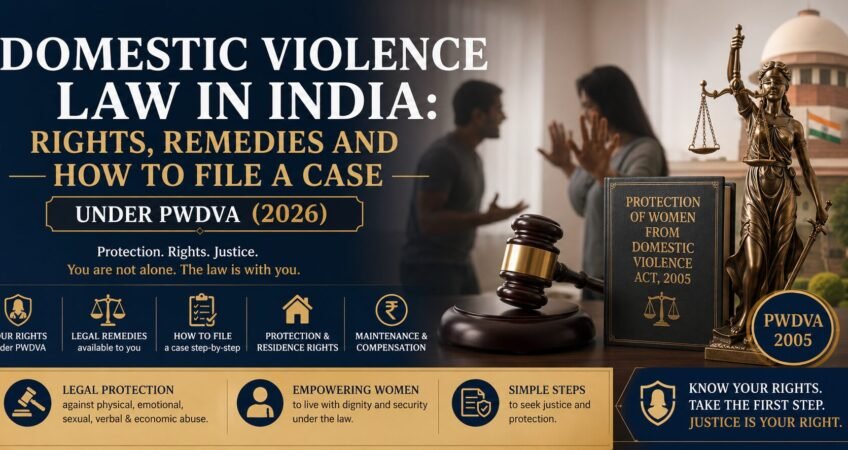
Domestic Violence Law in India: Rights, Remedies and How to File a Case Under PWDVA (2026)
Written by Adv. Karan Dua | Matrimonial Law Specialist | Delhi High Court & Supreme Court of India 8 Years Exclusive Practice in Family & Matrimonial Law | Jangpura, New Delhi
Of all the cases that come through my office, domestic violence cases carry a particular weight. The person sitting across from me has often been suffering for months — sometimes years — before finally deciding to seek legal help. By the time they walk in, they have usually convinced themselves of at least one of three things: that what is happening to them does not legally qualify as domestic violence, that the law cannot protect them quickly enough, or that filing a case will make things worse.
All three beliefs are almost always wrong.
The Protection of Women from Domestic Violence Act, 2005 — commonly called PWDVA or the DV Act — is one of the most comprehensive pieces of civil legislation protecting women in India. It is faster than most people expect, broader in scope than most people realise, and more protective than most people give it credit for. The problem is not the law. The problem is that most people do not know what it says or how to use it.
This guide changes that.
What Is the Protection of Women from Domestic Violence Act, 2005?
The PWDVA, 2005 is a central legislation enacted to protect women from domestic violence within a domestic relationship. Before this law existed, a woman experiencing violence in her marriage had limited civil remedies — she could file a criminal complaint, or she could sue for divorce, but there was no dedicated civil framework giving her immediate, enforceable protection while she remained in the relationship.
The DV Act changed that fundamentally. It created a civil remedy that is:
- Fast — courts can pass interim orders within days
- Broad — covering physical, sexual, verbal, emotional, and economic abuse
- Inclusive — protecting women in marriages, live-in relationships, and shared households of all kinds
- Practical — giving women the right to stay in their home, claim monetary relief, and get protection from further abuse, all under one application
It is important to understand from the outset that the DV Act is a civil law, not a criminal one. A complaint under PWDVA does not automatically lead to arrest. It leads to court orders. This distinction matters — and we will return to it.
What Counts as Domestic Violence Under PWDVA?
Most people associate domestic violence with physical assault. The DV Act defines it far more broadly. Under Section 3 of the Act, domestic violence includes any of the following acts, omissions, or conduct by the respondent:
Physical Abuse
Any act or conduct that causes bodily pain, harm, or danger to life, limb, or health. This includes assault, battery, slapping, kicking, pushing, throwing objects, and any other form of physical harm.
Sexual Abuse
Any conduct of a sexual nature that abuses, humiliates, degrades, or violates the dignity of the woman. Marital rape — though not yet a criminal offence under Indian law in all circumstances — can constitute domestic violence under PWDVA and may be the basis for a protection order and divorce on grounds of cruelty.
Verbal and Emotional Abuse
This is the category most people underestimate. It includes:
- Insults, ridicule, and humiliation — particularly about the woman’s character, conduct, or appearance
- Name-calling and abusive language
- Threats of harm or injury to the woman or anyone she loves
- Humiliation in front of children, extended family, or in public
- Repeated threats of divorce or abandonment used as control
- Threats to take away children or to harm them
Courts have consistently held that sustained verbal and emotional abuse, even without any physical violence, constitutes domestic violence under the Act.
Economic Abuse
This is perhaps the least understood and most common form of abuse in many Indian households. Economic abuse under PWDVA includes:
- Depriving a woman of financial resources she is entitled to — including her own earnings, property, or stridhan
- Preventing her from accessing bank accounts, income, or household money for basic necessities
- Disposing of property, assets, or valuables she has a right to
- Prohibiting her from taking up employment
- Withholding rent, household expenses, or money for the children’s education and medical needs
A woman does not have to be beaten to be a victim of domestic violence. A woman who controls her own money, goes to work, and has no visible injuries — but whose husband takes her salary, forbids her from spending, and keeps her financially dependent — is experiencing domestic violence under Indian law.
Who Is Protected Under the DV Act?
The Aggrieved Person
The DV Act protects women who are or have been in a domestic relationship with the respondent. This includes:
- Wife — in a legally solemnised marriage
- Live-in partner — a woman in a relationship “in the nature of marriage,” which courts have broadly interpreted to include long-term live-in relationships where the couple presented themselves as husband and wife
- Mother, sister, or daughter — of the respondent, if she lives in the shared household and is subjected to domestic violence by him
- Daughter-in-law — protected against abuse by in-laws, not just the husband
The PWDVA is expressly gender-specific: it protects women from male respondents, and in some cases, from female relatives of the respondent (such as a mother-in-law who participates in harassment).
Who Can Be the Respondent?
Any adult male member of the household who has been in a domestic relationship with the aggrieved person. In the context of married women, this typically means the husband and, where applicable, his male relatives. A respondent can also be a female relative of the husband in limited circumstances, particularly in dowry harassment cases.
Types of Orders a Court Can Grant Under PWDVA
The DV Act gives courts the power to pass several types of orders, and these are the law’s real teeth:
Protection Order (Section 18)
This is the most immediate remedy. A Magistrate can order the respondent to:
- Stop committing acts of domestic violence
- Stop entering the aggrieved person’s workplace, school, or any place she frequently visits
- Stop making contact with her — in person, by phone, or through others
- Stop alienating her assets or stridhan
- Stop causing violence to her relatives, friends, or children
A protection order is a restraining order with consequences. Violation of a protection order is a criminal offence punishable with imprisonment of up to one year and a fine of up to ₹20,000 under Section 31 of the Act.
Residence Order (Section 19)
This order is about the roof over a woman’s head — and it is one of the most significant protections the DV Act offers.
A Magistrate can order that:
- The aggrieved person shall not be evicted or excluded from the shared household, regardless of who owns it
- The respondent shall not disturb her possession of the household
- The respondent shall vacate the shared household
- The respondent shall not alienate or dispose of the shared household
- Alternate accommodation be provided to the aggrieved person at the respondent’s expense
This means a woman cannot be thrown out of her matrimonial home — even if the home is owned entirely by her husband or his family — while a DV case is active. This is a right courts take seriously.
Monetary Relief (Section 20)
The Magistrate can direct the respondent to pay monetary relief to the aggrieved person for losses suffered as a result of domestic violence, including:
- Loss of earnings
- Medical expenses
- Damage to property
- Maintenance for herself and her children
Monetary relief can be ordered as a recurring monthly payment or as a lump sum, and it can be ordered in addition to — not instead of — maintenance under other laws such as Section 125 CrPC or Section 24 of the Hindu Marriage Act.
Custody Order (Section 21)
The Magistrate can pass interim custody orders for the children of the aggrieved person, ensuring they are not separated from their mother during proceedings. This is a temporary order and does not prejudice final custody determination by the Family Court.
Compensation Order (Section 22)
In addition to monetary relief, a court can direct the respondent to pay compensation to the aggrieved person for injuries — including mental torture and emotional distress — caused by domestic violence.
How to File a Domestic Violence Case: Step by Step
Step 1: Reach a Protection Officer or Service Provider
You do not need to approach a court directly to begin a DV case. The DV Act created a dedicated infrastructure of Protection Officers — government-appointed officials in every district — specifically to help aggrieved women file complaints, access shelters, medical facilities, and legal aid.
In Delhi, Protection Officers are typically attached to the District Social Welfare Office. You can also approach:
- An NGO registered as a Service Provider under the Act
- The police (who are obligated to assist you in reaching a Protection Officer)
- A lawyer, who can help you file a Domestic Incident Report and petition directly
Step 2: File a Domestic Incident Report (DIR)
A Protection Officer prepares a Domestic Incident Report (DIR) — a formal written record of the incidents of domestic violence. This document becomes the foundation of your case. It records the details of the relationship, the nature of the abuse, the names of the respondents, and the reliefs you are seeking.
Be as specific and factual as possible when describing incidents. Dates, locations, what was said or done, and who was present — all of this strengthens the DIR.
Step 3: File an Application Before the Magistrate
An application for relief under PWDVA is filed before the Judicial Magistrate First Class (JMFC) in the area where:
- The aggrieved person permanently or temporarily resides, or
- The respondent resides, or
- The domestic violence took place
In Delhi, these applications are typically filed in the Metropolitan Magistrate courts at Saket, Dwarka, Rohini, Karkardooma, or Patiala House, depending on the area.
Step 4: Court Issues Notice to the Respondent
Once the application is filed, the court issues notice to the respondent and the Protection Officer. The court can also pass an ex parte interim order — an order passed without hearing the respondent — if it is satisfied that the situation warrants immediate protection. This ex parte interim relief is what makes the DV Act faster than most other legal proceedings.
Step 5: Hearing and Final Orders
After the respondent is heard, the court passes its final orders on protection, residence, monetary relief, custody, and compensation. The entire proceeding is designed to be completed within 60 days of the first date of hearing — though in practice, contested DV cases frequently take longer.
Can You Get a Protection Order on the Same Day?
Yes — in genuinely urgent circumstances. Section 23 of the PWDVA specifically empowers a Magistrate to pass an ex parte interim protection order on the same day an application is filed, without hearing the respondent, if the Magistrate is satisfied that there is a prima facie case of domestic violence and that the situation is urgent.
I have obtained same-day protection orders for clients facing imminent threats. These orders are not routine — they require your lawyer to present the urgency clearly and convincingly — but the law explicitly provides for them.
Evidence That Strengthens a Domestic Violence Case
Courts decide DV cases on the balance of probabilities — a lower threshold than the criminal standard of “beyond reasonable doubt.” This means evidence does not have to be perfect. But stronger evidence leads to stronger orders.
Medical records: Hospital records, doctor’s notes, and injury certificates are among the most powerful evidence in physical abuse cases. If you have been assaulted, seek medical attention and ask for documentation, even if you do not file a complaint immediately.
Photographs and videos: Document injuries with photographs. If you have video or audio recordings of incidents of abuse, preserve them carefully. Under Section 63 of the Bharatiya Sakshya Adhiniyam (BSA), 2023 — which replaced the Indian Evidence Act — electronic evidence is admissible when properly certified.
WhatsApp messages and call recordings: Abusive or threatening messages, voice notes, and call recordings can all be produced as evidence. Save and back them up outside the shared device. Courts in Delhi regularly admit WhatsApp evidence in matrimonial and DV proceedings.
Bank statements and financial records: In cases of economic abuse, bank statements showing the respondent’s income, your lack of access to funds, or unexplained transfers of joint assets are critical.
Witness statements: Neighbours, family members, domestic helpers, and even children (where appropriate) can give evidence. Affidavits from credible witnesses who have seen or heard incidents of abuse significantly strengthen a case.
FIR or police complaint copies: If you have previously complained to the police — even informally — obtain copies. A consistent record of complaints over time builds a compelling narrative.
Letters, emails, or social media messages: Controlling, threatening, or abusive messages from any platform are relevant and admissible.
What If You Need to Leave the Shared Home Urgently?
If you are in immediate danger, your priority is physical safety, not legal proceedings. Leave the home if you can do so safely. Take important documents with you — your Aadhaar, passport, marriage certificate, children’s birth certificates, your own bank card, and any evidence of abuse you can safely carry.
Once you are safe, contact a lawyer or a Protection Officer immediately. You can file for both a protection order and a residence order from wherever you are — you are not required to return to the shared household to file a case.
In Delhi, several government-run Shelter Homes (Swadhar Grehs) and NGO-run safe houses accept women and children fleeing domestic violence, providing temporary accommodation while legal proceedings begin.
How Domestic Violence Interacts with Divorce and Other Proceedings
Filing a DV case and filing for divorce are two separate legal proceedings — and they can run simultaneously.
DV case and divorce: Domestic violence — particularly sustained physical cruelty or mental cruelty — is one of the strongest grounds for divorce under the Hindu Marriage Act. Evidence gathered in a DV case can be used in a subsequent divorce petition. Many of our clients file both simultaneously.
DV case and 498A: Where domestic violence is accompanied by dowry harassment, the respondent may also be liable under Section 498A IPC. The DV Act provides civil remedies; 498A is a criminal provision. The two can be pursued together — each through its own forum.
DV case and maintenance: Monetary relief under Section 20 of PWDVA is separate from maintenance under Section 125 CrPC or Section 24 of the Hindu Marriage Act. A woman can claim all three, and courts typically consider them together when deciding quantum. See our detailed guide on maintenance law in India.
DV case and child custody: An interim custody order under Section 21 of PWDVA does not replace the Family Court’s jurisdiction over custody. It is a temporary protective measure. Long-term child custody is determined separately, but evidence from DV proceedings is highly relevant to those decisions.
What Protections Exist for Men Experiencing Domestic Violence?
The DV Act is gender-specific and protects only women. Men who experience abuse within a marriage or relationship do not have a remedy under PWDVA.
However, men in such situations are not entirely without recourse:
- A husband can allege cruelty — physical or mental — as a ground for divorce under the Hindu Marriage Act
- A husband subjected to false criminal complaints or harassment may have remedies under civil law (defamation) or criminal law (filing counter-complaints for false evidence or extortion)
- In cases where a husband faces sustained mental cruelty documented over time, courts have granted divorce on those grounds even where there has been no physical violence
I deal with cases from both sides. If you are a husband who has experienced sustained abuse and is considering your legal options, consult a qualified matrimonial lawyer in Delhi for a frank assessment of what the law can and cannot do for you.
Common Mistakes to Avoid in a Domestic Violence Case
Delaying action. Every day without legal protection is a day the pattern of abuse continues. Courts cannot grant protection retroactively. File early.
Not documenting incidents as they happen. The moment it is safe to do so, write down what happened — the date, time, what was said or done, and who was present. A contemporaneous record is far more credible than memory recalled months later in court.
Sharing the case details on social media. Anything posted publicly about the case, the respondent, or the proceedings can be used against you in court. Say nothing about the case online.
Settling too quickly under pressure. Families, in-laws, and sometimes well-meaning mediators push for quick settlement. A settlement under pressure, without proper legal advice, often means giving up rights you did not know you had. Consult your lawyer before agreeing to anything.
Going back to the respondent without a plan. Courts understand reconciliation. What courts cannot do is protect you if you return to the shared household without any agreed framework or legal protection in place. If reconciliation is possible, do it with legal safeguards — a written undertaking at minimum, ideally a formal agreement.
Withdrawing the case without understanding the consequences. Withdrawing a DV application or complaint has implications for future proceedings. Never withdraw without first discussing it thoroughly with your lawyer.
Frequently Asked Questions
Can I file a domestic violence case without a lawyer?
Yes. The DV Act is specifically designed to be accessible without legal representation — you can file through a Protection Officer or Service Provider directly. However, having a lawyer significantly improves the quality of your application, the evidence you present, and the speed at which you obtain meaningful relief. Legal aid is available for those who cannot afford a lawyer through the Delhi Legal Services Authority (DLSA).
Is domestic violence a criminal or civil matter in India?
The DV Act is a civil law. Filing under PWDVA results in civil orders — protection, residence, monetary relief — not FIRs or arrests. However, if the domestic violence also involves acts that are criminal offences — assault, criminal intimidation, dowry harassment under Section 498A — those can be prosecuted simultaneously through criminal law. The two tracks are separate but often run together.
Can I stay in my matrimonial home during a domestic violence case?
Yes — this is one of the most important rights the DV Act confers. You cannot be evicted from the shared household while a DV application is pending. This right exists even if you are not a co-owner of the property and even if the property belongs to your husband’s parents. Courts have consistently upheld this right and will pass Residence Orders to enforce it.
How long does a domestic violence case take in India?
The DV Act directs courts to dispose of applications within 60 days of the first hearing. In practice, contested cases — where the respondent actively disputes the allegations — take longer, often six months to two years depending on the court’s workload and the complexity of the issues. Interim orders, however, can be obtained within days to weeks, providing immediate protection while the full case proceeds.
Conclusion
Domestic violence is not just what happens when someone is hit. It is what happens when someone’s voice is silenced, their money is controlled, their dignity is stripped, and their sense of safety is destroyed — day by day, behind closed doors. The law recognises this. The DV Act was written to recognise this.
If you are experiencing any form of domestic abuse — physical, sexual, verbal, emotional, or financial — you have rights. You have remedies. And you have the law firmly on your side.
The first step is always the hardest. But it is the one that changes everything.
If you are in Delhi or anywhere in NCR and need to speak to someone about a domestic violence situation — whether to file a case, understand your options, or simply know where you stand — reach out to us. Every consultation is confidential. Every case is handled with the sensitivity it deserves.
Adv. Karan Dua Advocate · Delhi High Court · Matrimonial & Family Law Adv. Karan Dua is a Delhi-based advocate specialising in matrimonial disputes, divorce litigation, domestic violence proceedings, and child custody matters. He practises before the Delhi High Court and family courts across the NCR, with a focus on evidence strategy and asset tracing in complex matrimonial matters