
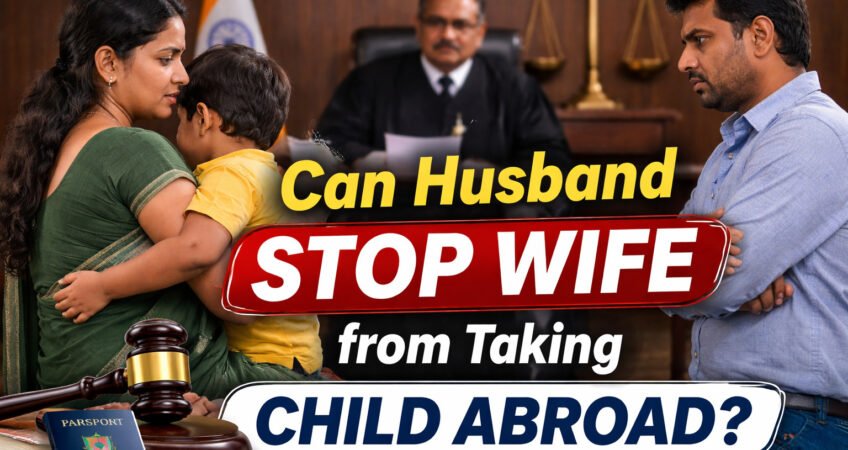
Can a husband stop a wife from taking a child abroad?
Disputes relating to a child’s relocation or travel abroad are increasingly common in matrimonial conflicts. Such situations often arise during divorce proceedings, custody battles, or even after separation. Indian courts approach these matters with a clear and consistent principle — the welfare and best interest of the child is paramount above all else.
This article provides a detailed understanding of whether a husband can legally stop his wife from taking their child abroad, and what remedies are available under Indian law.
-
Legal Position Under Indian Law
In India, both parents generally have rights over their child, especially in the absence of a court order granting exclusive custody. However, these rights are not absolute.
The governing principle is derived from laws such as:
- Guardians and Wards Act, 1890
- Hindu Minority and Guardianship Act, 1956 (for Hindus)
Under these laws, courts prioritize:
✔ Welfare of the child
✔ Emotional, educational, and social development
✔ Stability and security
-
Can a Husband Directly Stop the Wife?
No, a husband cannot unilaterally stop his wife from taking the child abroad.
He must seek legal intervention. Without a court order, merely objecting or protesting does not have legal enforceability.
-
Legal Remedies Available to the Husband
(a) Filing for Injunction / Stay Order
The husband can approach the Family Court and seek an injunction restraining the wife from taking the child out of India.
The court may grant:
- Temporary restriction (interim order)
- Conditional permission (e.g., travel with safeguards)
(b) Child Custody Petition
If custody is disputed, the husband may file for custody or guardianship. Along with this, he can request restrictions on international travel.
(c) Look-Out Circular (LOC)
In urgent situations where there is a risk of the child being taken out of India without consent, a Look-Out Circular may be initiated through proper legal channels.
This is usually considered in serious cases involving:
- Fear of permanent relocation
- Violation of existing custody orders
(d) Passport Objections
If the child’s passport is being issued or renewed, the husband can raise objections before the passport authority, especially where consent of both parents is required.
-
Important Factors Considered by Courts
Courts do not automatically restrict travel. Each case is examined on its own merits. Key considerations include:
✔ Best Interest of the Child (most important factor)
✔ Existing custody arrangements
✔ Age and emotional needs of the child
✔ Purpose of travel (education, tourism, medical reasons, etc.)
✔ Duration of stay abroad
✔ Risk of child not returning to India
✔ Financial and social stability of both parents
✔ Consent or objections of the other parent
-
Situations Where Courts May Allow Travel
Indian courts often permit international travel if it benefits the child. Common scenarios include:
- Higher education opportunities abroad
- Medical treatment unavailable in India
- Temporary visits (vacations, family functions)
- Better living conditions or exposure
However, courts may impose safeguards such as:
✔ Undertaking to return to India
✔ Submission of travel itinerary
✔ Security deposit or surety
✔ Regular virtual contact with the other parent
- Situations Where Courts May Restrict Travel
Courts may refuse permission or impose restrictions if:
- There is a risk of parental abduction
- The parent has previously violated court orders
- The move may disrupt the child’s education or stability
- Travel appears to be an attempt to defeat custody rights
-
Role of Consent in International Travel
For minors, consent of both parents is generally required for:
- Passport issuance
- Visa processing (in many countries)
Lack of consent can become a strong ground for legal intervention.
-
Key Judicial Approach
Indian judiciary consistently holds that:
“Parental rights are subordinate to the welfare of the child.”
This means neither the mother nor the father has an automatic superior claim. The child’s happiness, safety, and development remain central to every decision.
-
Practical Advice for Parents
- Avoid taking unilateral decisions regarding international travel
- Seek mutual consent wherever possible
- Maintain transparency regarding travel plans
- Approach the court early in case of disputes
- Focus on the child’s well-being rather than personal conflicts
Conclusion
A husband can legally stop his wife from taking their child abroad — but only through proper legal procedures and court intervention. Courts carefully balance parental rights with the child’s best interests before granting or denying permission.
Understanding your legal rights and responsibilities can help prevent conflict and ensure that decisions are made in the best interest of the child.
(FAQs)
1. Can a wife take a child abroad without the father’s consent?
In general, taking a child abroad without the father’s consent can lead to legal complications, especially if custody is disputed. Courts may intervene if the father challenges the move. Consent of both parents is usually important for smooth travel and legal compliance.
2. Can a husband stop his wife at the airport from taking the child abroad?
No, a husband cannot physically or directly stop the wife at the airport without a court order. However, if there is a valid court order or a Look-Out Circular (LOC), authorities may prevent the child from leaving the country.
3. What is a Look-Out Circular (LOC)?
A Look-Out Circular is a legal mechanism used to alert immigration authorities to prevent a person (including a child) from leaving India in certain situations, usually issued in serious disputes or legal proceedings.
4. Does the father’s consent matter for a child’s passport?
Yes, in most cases, the consent of both parents is required for issuing a minor’s passport. If one parent objects, the matter may require legal clarification or court intervention.
5. What if there is no custody order in place?
If no custody order exists, both parents generally have equal rights. However, taking the child abroad without informing the other parent may still be challenged in court.
6. Can the court allow the child to travel abroad without the father’s consent?
Yes, courts can allow travel without the father’s consent if it is in the best interest of the child. The court may impose conditions to ensure the child returns to India.
7. What safeguards can courts impose while allowing travel?
Courts may require:
✔ Return undertakings
✔ Submission of travel details
✔ Security deposits
✔ Regular communication with the other parent
8. Can a father get custody just to stop the child from going abroad?
No, custody decisions are not made solely to restrict travel. Courts decide custody based on the child’s welfare, not parental disputes.
9. What if the mother does not return with the child?
If a parent does not return the child as per court directions, it can lead to serious legal consequences, including contempt of court and further custody litigation.
10. Which factor is most important in such cases?
The welfare and best interest of the child is always the most important factor considered by Indian courts.
Written by Adv. Karan Dua, practising in Delhi, focuses on matrimonial and family law matters.